“In Brunei, Pork Can Only Be Sold by Licensed Non-Muslim Businesses — Not Banned Entirely”
Brunei does not ban pork sales outright, but strictly regulates them: pork and pork products may only be sold through licensed, non-Muslim-operated businesses with mandatory separation of storage and premises from halal food operations. Selling pork in any establishment holding a halal certificate — or without proper licensing — is a criminal offence.
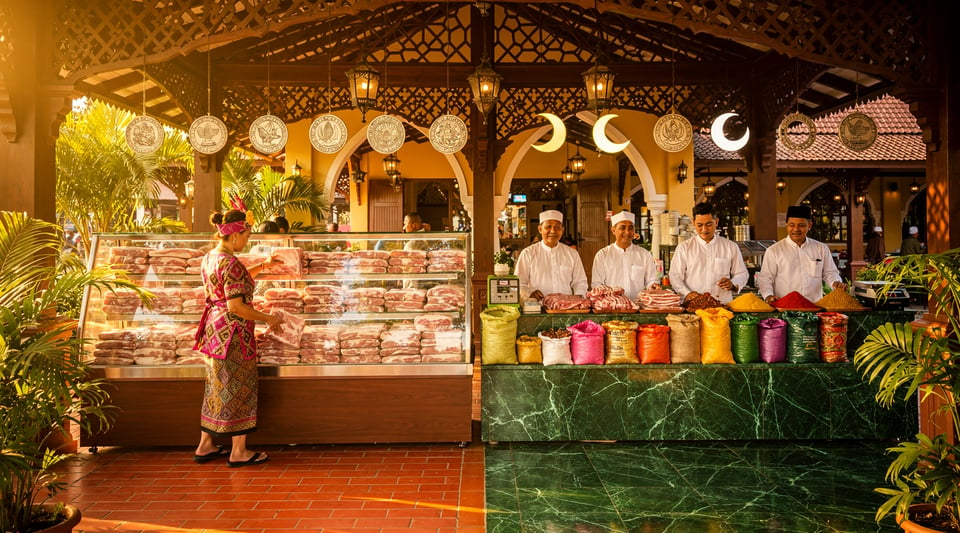
An Islamic monarchy shapes food law
Brunei Darussalam is an absolute Islamic monarchy governed by the 'Melayu Islam Beraja' (Malay Islamic Monarchy) national ideology, with Islam enshrined as the state religion. This shapes every aspect of food law in the country.
Building the halal certification framework
The formal legislative framework for halal regulation began with a 1997 speech by Sultan Hassanal Bolkiah stressing the importance of halal standards, which prompted the enactment of the Halal Meat Act (Chapter 183) in 1998. The Halal Food Control Division (BKMH) was established under the Ministry of Religious Affairs to oversee enforcement. In 2005, the Halal Certificate and Halal Label Order was introduced, initially on a voluntary basis. A major escalation came in 2017 when the Amendment Order made halal certification compulsory for all food businesses — restaurants, cafes, food stalls, factories, and home-based food producers alike. This means every business in the country's food supply chain must obtain official MUIB certification proving its products and premises are free from pork, alcohol, and other haram ingredients.
Pork remains available through separate channels
There is no domestic pork production in Brunei; all pork is imported from the neighbouring Malaysian state of Sarawak. Pork remains legally available to Brunei's non-Muslim minority — primarily ethnic Chinese — but only through non-halal-licensed shops and eateries that are clearly separated from halal businesses.
Enforcement carries real penalties
Non-compliance with halal regulations can result in imprisonment, and a halal certificate can be revoked if a pork-related contaminant is discovered — as occurred in 2026, when a halal certificate was revoked after a pork-derived brush was found at an ice cream shop.
Where the story gets it wrong
The claim is often overstated as a blanket 'ban on pork sales.' In reality, pork is not banned in Brunei — it is regulated. Non-Muslim-operated businesses can legally sell pork, subject to licensing and strict separation from halal businesses; pork is even legally imported from Malaysia.
Under the Halal Certificate and Halal Label Order 2005 (S 39/05, Chapter 183 subsidiary legislation) and its mandatory Amendment Order 2017, all food businesses in Brunei must obtain halal certification from the Majlis Ugama Islam Brunei (MUIB). A halal-certified premises is legally prohibited from handling, storing, or selling pork or any non-halal product. The Halal Certificate and Halal Label Order further requires strict separation of food storage and business premises. Pork may only be commercially sold through non-halal-licensed (i.e., non-Muslim-operated) establishments, subject to licensing requirements. The Halal Meat Act (Chapter 183, S 30/1998, revised 2014) separately governs the importation, slaughtering, distribution, and sale of halal meat, and effectively restricts the general meat supply chain to halal-certified products. Violations carry a fine of up to BND 8,000 (approx. USD 6,316) or up to two years' imprisonment, or both.
- Current status
- Actively Enforced
- Enacted
- September 17, 1998
- Penalty
- Fine up to BND 8,000 (approx. USD 6,316) or up to 2 years' imprisonment, or both. Additional daily fines of up to BND 100 for continuing offences. Separate offences (e.g., displaying expired certificates, obstructing officers) carry fines up to BND 4,000 or 1 year imprisonment.Fine: up to BND8,000Imprisonment: 2 years
- Jurisdiction
- National law applying throughout Brunei Darussalam, administered by the Ministry of Religious Affairs (MORA) and enforced by the Halal Food Control Division (BKMH) and Majlis Ugama Islam Brunei (MUIB).