“California Law: Dead Frog-Contest Frogs Can't Be Eaten — They Must Be Destroyed”
California law prohibits anyone from eating — or using for any purpose — a frog that dies during a frog-jumping contest. The dead frog must instead be destroyed as soon as possible.
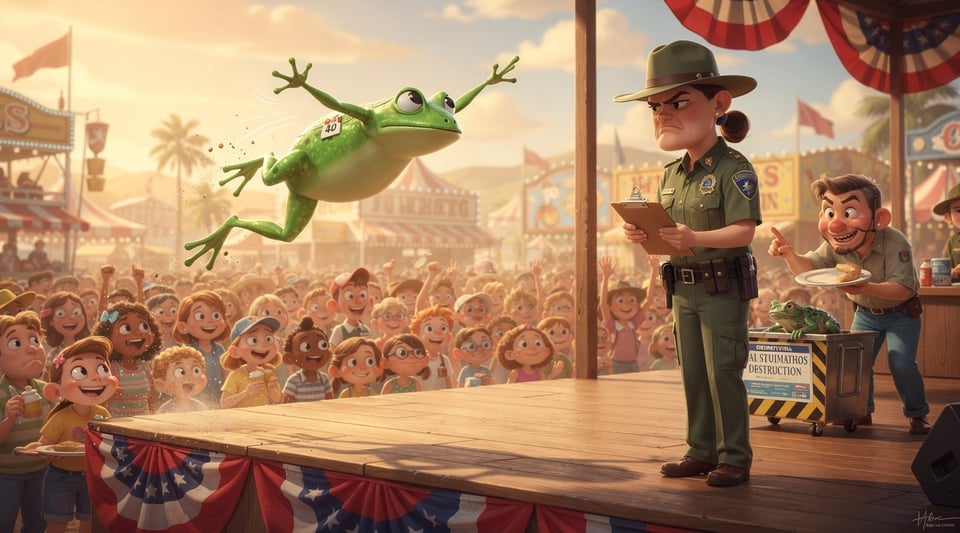
The Twain Story Behind the Law
This quirky California law owes its existence to one of the most famous short stories in American literary history. In 1865, a young Samuel Clemens — not yet famous as Mark Twain — spent weeks stranded by rain in Angels Camp, a small Gold Rush town in Calaveras County. There, he heard a tall tale about a trained jumping frog whose owner lost a bet after a trickster secretly weighted the frog with buckshot. Twain turned the yarn into 'The Celebrated Jumping Frog of Calaveras County,' the story that launched his international career.
From Tall Tale to Annual Tradition
In 1928, to celebrate the paving of Angels Camp's main road, locals organized the first official Jumping Frog Jubilee in Twain's honor. The contest grew into a beloved annual tradition — by 2007 it attracted around 4,000 frog entries and tens of thousands of spectators.
California Codifies the Contest
With such a prominent contest drawing national attention, California legislators passed a dedicated Article of the Fish and Game Code (Article 2, §§ 6880–6885) in 1957 to regulate frog-jumping contests specifically, carving them out from standard hunting and fishing license requirements.
Frog Welfare Rules Today
The Calaveras County contest continues today, enforcing a strict Frog Welfare Policy that includes limiting the number of daily jumps per frog and playing calming music in the frog enclosures.
Where the story gets it wrong
The law is sometimes treated as a generic 'California weird law,' but it applies only to frogs used in formally organized, publicly advertised frog-jumping contests — not to frogs caught or kept for other purposes. Frogs obtained for food sales or scientific use fall under a separate section, § 6852.
The statute does not ban frog-jumping contests — it enables them by exempting contest frogs from standard fishing license and season requirements, while imposing the no-eating disposal rule as a condition of that exemption.
Any person may possess any number of live frogs to use in frog-jumping contests, but if such a frog dies or is killed, it must be destroyed as soon as possible, and may not be eaten or otherwise used for any purpose. (Cal. Fish & Game Code § 6883)
- Current status
- Rarely Enforced
- Enacted
- January 1, 1957
- Penalty
- Misdemeanor under Cal. Fish & Game Code § 12002; fine up to $1,000 and/or up to 6 months in county jailFine: up to USD1,000Imprisonment: 180 days
- Jurisdiction
- Applies statewide in California. Most prominently relevant to the annual Calaveras County Fair & Jumping Frog Jubilee in Angels Camp, CA.