“Colorado Once Made It Illegal to Catch a Drop of Rain — Here's the Truth”
Colorado's notorious Prior Appropriation doctrine once made almost all rainwater collection illegal without a water rights permit. Since 2016, most residents can collect up to 110 gallons in two rain barrels — no permit required — but large-scale collection without authorization remains prohibited.
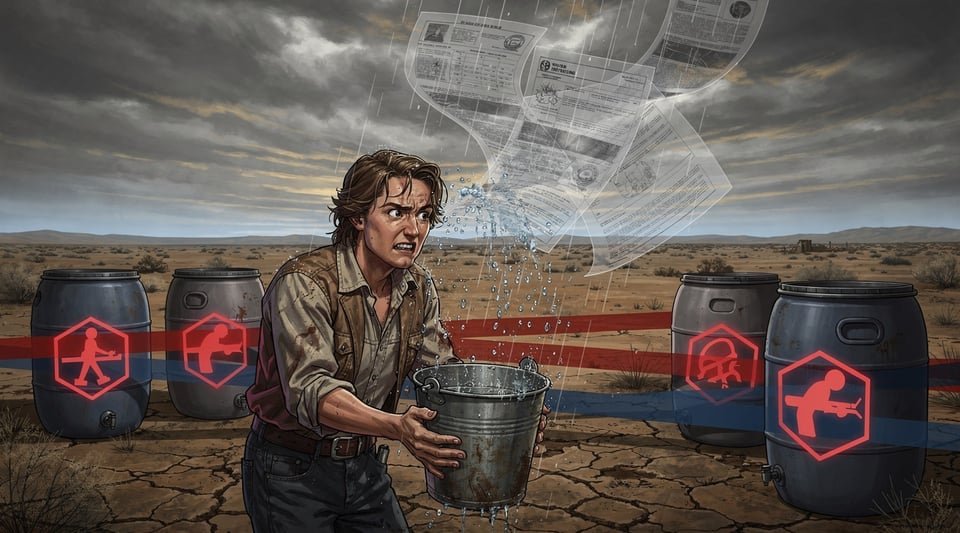
Prior Appropriation and the Water Doctrine
Colorado's relationship with rainwater is one of the most legally peculiar in the world. The state's constitution — shaped in the 1860s by miners and farmers competing for scarce water on an arid frontier — enshrined the 'Prior Appropriation' doctrine: 'first in time, first in right.' Under this framework, every drop of precipitation is treated as part of the public watershed, pre-allocated to downstream water rights holders. That meant placing a bucket under a downspout was, for most Coloradans, technically an act of theft from senior water rights holders who had legal claims to that water as it flowed into streams and aquifers.
A Century of Prohibition
For over a century, Colorado remained one of the only places on earth where the average homeowner could not legally collect rain off their own roof. Agriculture lobbyists and downstream water rights holders fiercely defended the status quo, arguing that even small residential collection could, in aggregate, deprive farmers and municipalities of their legally decreed allocations.
Incremental Legal Reform
Change came incrementally. In 2009, Senate Bill 09-080 created a limited exception for rural residents with exempt well permits, allowing them to obtain a Rooftop Precipitation Collection System Permit and collect unlimited roof runoff — but only for uses mirroring their well permit allowances. Broader reform proved politically difficult; the legislature rejected rainwater collection bills multiple times before finally passing House Bill 16-1005 in 2016, signed by Governor John Hickenlooper. A key enabler was a Colorado State University study showing that household rain barrels would cause no measurable injury to downstream rights.
Today's Rain Barrel Rules
Today, most Colorado homeowners can legally use two rain barrels — a modest but historically significant concession. The law still specifically bars indoor use, drinking, and off-property transfer of collected water. Homeowners' associations are also prohibited from banning rain barrels, though they may impose aesthetic rules. The 110-gallon cap is famously stingy compared to states like Texas (unlimited) or Utah (2,500 gallons), but for Colorado, it represents a seismic shift in a water culture built on scarcity.
Where the story gets it wrong
Myth: all rainwater collection in Colorado is illegal without a water rights permit. This was historically accurate but is now outdated — since August 10, 2016, most residential homeowners can collect up to 110 gallons in two rain barrels with no permit required.
Myth: Colorado has fully liberalized rainwater harvesting. In fact, collection beyond the 110-gallon threshold, by commercial properties, or for indoor or potable use remains tightly restricted, and the law does not grant a water right — the state engineer can still curtail use if material injury to downstream rights is shown.
Under Colorado Revised Statute §37-96.5-103 (established by House Bill 16-1005, 2016), any single-family or small multi-family residence (4 units or fewer) may collect rainwater from rooftop downspouts in up to two rain barrels with a combined capacity of no more than 110 gallons, without a permit, for outdoor non-potable uses (lawn irrigation, gardening, car washing, etc.) on the same property. Separately, under C.R.S. §§37-92-602(1)(g) and 37-90-105(1)(f) (Senate Bill 09-080, 2009), rural residents with qualifying exempt residential well permits may collect an unlimited volume of rooftop rainwater after obtaining a Rooftop Precipitation Collection System Permit from the Colorado Division of Water Resources. Collection beyond these statutory allowances remains subject to Colorado's Prior Appropriation doctrine and is effectively prohibited without a valid water right.
- Current status
- Actively Enforced
- Enacted
- August 10, 2016
- Penalty
- Violations of Colorado water law (collecting beyond permitted amounts or without required permits) can result in cease-and-desist orders from the State Engineer. Willful violations of the Prior Appropriation system can constitute contempt of a water court decree; penalties vary by case. The Division of Water Resources may order cessation of illegal collection activity.
- Jurisdiction
- State of Colorado. Applies uniformly statewide; local municipalities may impose additional requirements but cannot be more permissive than state law allows.