“Estonia Bans Names of Famous Historical Figures — But Not How You Think”
Estonia's Names Act does prohibit using the name of a well-known historical figure — but this restriction applies only to adults changing their *surname*, not to parents choosing a given (first) name for a newborn child. The popular claim misidentifies both the type of name affected and the reason behind the rule.
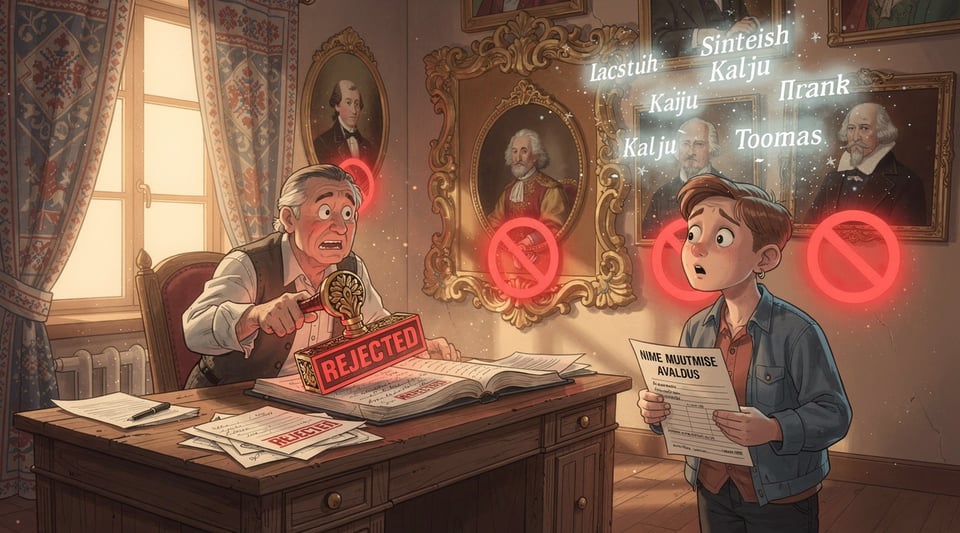
A History of Forced Identity Changes
Estonia has one of Europe's most detailed and actively enforced naming law frameworks, rooted in a turbulent history of forced identity changes. After centuries under German, Swedish, Danish, and Russian rule, Estonians began systematically acquiring hereditary surnames only in the early 19th century. The nationalist 1930s saw a government-backed 'Estonianization' campaign, pressuring citizens to replace foreign surnames with Estonian-sounding ones. Post-Soviet independence in 1991 brought a further wave of name restoration as citizens shed Soviet-era Russified forms.
The Modern Law's Surname Restriction
The modern Names Act (first enacted in its contemporary form in 2005, with significant amendments via RT I 2010, 1, 1) reflects these sensitivities. The prohibition on adopting the surname of a 'well-known historical figure or a famous family' is designed to protect the integrity of distinguished Estonian lineages and prevent individuals from falsely trading on the prestige of famous names — think someone legally renaming themselves 'Kalevipoeg' (Estonia's legendary folk hero) or 'Tammsaare' (a beloved national author).
Different Rules for Given Names
For given names at birth, the rules are genuinely quirky but different: names must be gender-appropriate, comply with Estonian orthography, not be offensive, and foreign names must be demonstrably in use elsewhere. The Supreme Court has actively adjudicated edge cases — in 2020 it initially ruled a name ending in 'y' incompatible with Estonian conventions, only for a 2021 case ('Nelery') to partially walk that back. There is no 'government approval' required for historical-figure first names specifically; the claim as typically stated is a garbled conflation of the surname rule with the birth-registration process.
Where the story gets it wrong
The claim is typically framed as applying to children's given (first) names at birth — it does not. The historical-figure restriction in Estonia's Names Act applies only to surname changes made by adults, not to naming a newborn.
The stated reason — 'to prevent confusion in official records' — is inaccurate; the actual rationale is protecting the prestige of well-known historical names and famous family lineages from being appropriated. A separate record-collision rule only blocks a name change if the new full name and year of birth would exactly duplicate those of another living person.
The process is not 'government approval' in the sense of a special permit — surnames falling into a prohibited category are simply refused outright at the vital statistics office.
Under the Estonian Names Act (Nimeseadus), Section governing surname assignment: 'Upon assigning a new surname...the following shall not be assigned as the new surname:...6) a name of a well-known historical figure or a famous family; 7) a name referring to a legal person or the protected part of a well-known registered trade mark.' For given names assigned at birth, the restrictions are different: names must comply with Estonian language and orthographic norms, must not contain numbers or non-alphabetical symbols, must not be contrary to good morals, must indicate the child's gender, and non-Estonian names must be in use as given names in another country. There is no blanket prohibition on historical figure first names for newborns.
- Current status
- Actively Enforced
- Enacted
- January 1, 2005
- Penalty
- Name registration is refused outright; no criminal penalty or fine. The vital statistics office declines to register the prohibited name and the applicant must choose a compliant alternative.
- Jurisdiction
- National law; applies across all of Estonia. Administered by the Ministry of the Interior via local vital statistics offices (Tallinn, Tartu, Pärnu, Jõhvi).