“Iceland Requires All Dogs to Be Registered — But Thousands Aren't”
Icelandic law requires dog owners to register their pets with local municipal authorities and pay an annual fee. While the national Animal Welfare Act (No. 55/2013) sets the framework, enforcement is delegated to municipalities — and a 2023 report found only about a quarter of Reykjavik's estimated 10,000 dogs were actually registered.
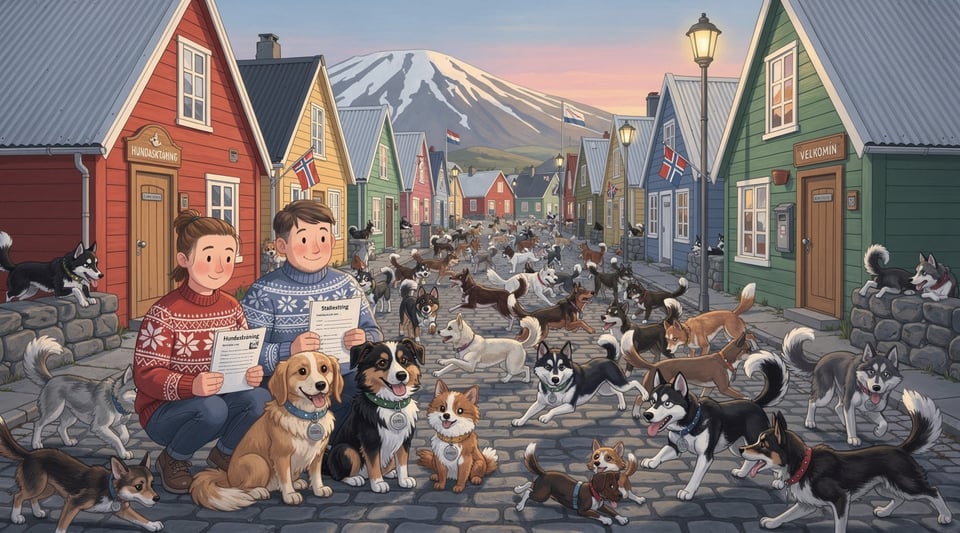
Deadly tapeworm epidemic prompted a dog ban
Iceland's strict dog registration laws are rooted in one of the most dramatic public health crises in the country's modern history. By the early 20th century, Reykjavik's rapidly urbanizing population brought large numbers of rural working dogs into the capital, where they mixed with strays and spread echinococcosis — a deadly tapeworm (Echinococcus granulosus) that can pass from dogs to humans, causing blindness, organ failure, and death. In the 1880s, a full 20% of autopsies in Iceland revealed the disease. The response was extreme: Law No. 8/1924 banned dogs from towns and urban areas entirely, and Reykjavik's regulation was even more severe — any dog found without a working permit could be summarily killed. Hundreds of dogs were destroyed; 170 were put down in 1948 alone.
2023
2023
2023
Ban lifted, replaced by a permit system
The ban lasted 60 years. It was finally lifted by Decree No. 385/1984, and completely replaced by a permit system in 2007. Today, dog ownership in Iceland is fully legal but tightly regulated. The national Animal Welfare Act (No. 55/2013) provides the overarching framework, while municipalities like Reykjavik administer the day-to-day rules, including a mandatory annual registration fee.
Registration gaps and a lasting cat culture
A 2023 report by the Reykjavik Grapevine revealed that only about a quarter of an estimated 10,000 dogs in Reykjavik were actually registered. The decades-long ban also shaped the city's culture: with no dogs around for two generations, cats became the dominant pet of Reykjavik, with roughly one cat for every ten residents today.
Where the story gets it wrong
The claim frames registration as a single, uniformly enforced national law. In reality, administration happens at the municipal level, and rules and fees for registration differ from one municipality to another, including in Reykjavik.
The 'fine' language is commonly conflated with the annual registration fee (15,700 ISK) — specific financial penalties for failing to register aren't prominently documented in English-language sources. Enforcement also appears weak: a 2023 report found about 75% of Reykjavik's dogs unregistered, undercutting any strong-deterrence framing.
The law is sometimes confused with the historical Reykjavik dog ban (1924–1984), which barred dogs from towns entirely and allowed unauthorized dogs to be killed — a far more severe regime than today's registration and fee requirement.
Under Iceland's Animal Welfare Act No. 55/2013 and municipal regulations, dogs must be registered with local authorities, microchipped, and fitted with an identification collar. In Reykjavik, registration is handled electronically through island.is, and dog owners are subject to an annual registration fee (15,700 ISK as of 2023, reduced by 30% if the owner completes a dog training program). Keeping a dog is not allowed except in the home of the owner, who must be 18 or older. Puppies must be registered no later than 4 months old. Dogs must also be kept on a leash in public spaces except in designated off-leash areas.
- Current status
- Rarely Enforced
- Enacted
- January 1, 2013
- Penalty
- Annual registration fee of 15,700 ISK (approx. €105 / $115 USD as of 2023); 30% discount if owner completes a dog training program. Specific fines for non-compliance not publicly quantified in available sources, but failure to register is a violation of municipal regulations.Fine: from ISK15,700
- Jurisdiction
- National framework under Animal Welfare Act No. 55/2013; day-to-day registration rules and fee schedules administered at the municipal level. Reykjavik rules documented most thoroughly.