“Talking to Wild Dolphins Isn't Illegal in the US — Feeding or Chasing Them Is”
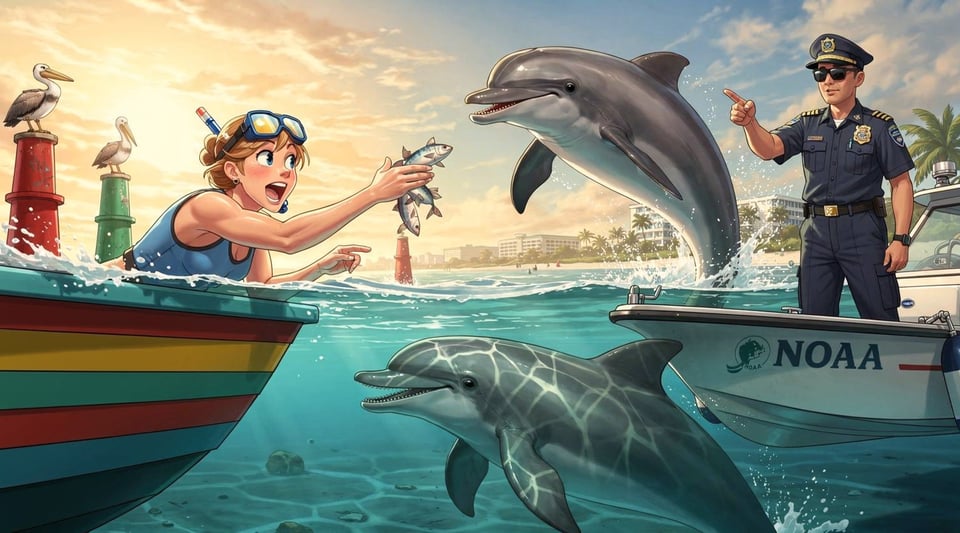
It is not illegal to talk to wild dolphins in the US: the Marine Mammal Protection Act of 1972 contains no ban on verbal communication. What it does prohibit is feeding, chasing, touching, or using sounds to lure them, all of which count as harassment. NOAA recommends watching wild dolphins from at least 50 yards.
Origins of the 1972 Marine Mammal Protection Act
Before 1972, marine mammals had almost no legal protection in the United States. Millions of dolphins died in tuna nets annually, and commercial hunting had pushed several species toward extinction. Congress passed the MMPA in October 1972 with strong bipartisan support, signed by President Nixon, creating a sweeping moratorium on the 'taking' of all marine mammals.
The 1991 feeding ban and court challenge
The feeding prohibition came slightly later: in 1991, NOAA's National Marine Fisheries Service amended the definition of 'take' to explicitly include 'feeding or attempting to feed' as a form of harassment. This rule survived a Fifth Circuit legal challenge in Strong v. United States (1993), where commercial dolphin-feeding tour operators argued NOAA had overstepped. The court disagreed.
Enforcement cases and Hawaii's distance rule
Real-world enforcement has been active: a 1999 NOAA case fined a Florida boat rental operator for encouraging tourists to feed dolphins; Hawaiian spinner dolphin tour operator Casey Cho was fined for 'leapfrogging' his boat in front of dolphin pods; and three snorkelers were fined after NOAA officers video-recorded them pursuing spinner dolphins off O'ahu. The case of 'Beggar,' a Panama City Beach dolphin repeatedly fed by tourists who became dependent on humans and bit tourists before dying, became a cautionary tale that shaped NOAA's enforcement approach. In Hawaii, a 2021 rule now specifically prohibits approaching spinner dolphins within 50 yards.
Where the story gets it wrong
Some claim it's illegal to 'talk to' wild dolphins. The MMPA contains no ban on verbal communication — saying hello from a safe distance is not a crime. What's illegal is feeding or attempting to feed them, chasing or pursuing them, touching them, or using sounds to lure them. Passive watching from 50+ yards is encouraged by NOAA.
Some believe the law doesn't apply if a dolphin approaches voluntarily. This is wrong: the law regulates human behavior, not dolphin behavior, so actively engaging with an animal that approaches you can still constitute harassment.
The Marine Mammal Protection Act (MMPA), 16 U.S.C. § 1372, prohibits any person subject to U.S. jurisdiction from 'taking' any marine mammal in U.S. waters or on the high seas. 'Take' is defined (50 CFR 216.3) to include harassing, hunting, capturing, collecting, or killing, or any attempt to do so. Feeding or attempting to feed wild marine mammals is explicitly listed as a form of harassment. 'Harassment' is split into Level A (potential to injure) and Level B (potential to disrupt behavioral patterns such as migration, breathing, nursing, breeding, feeding, or sheltering). NOAA policy states it 'cannot support, condone, approve, or authorize activities that involve closely approaching, interacting, or attempting to interact with whales, dolphins, porpoises, seals, or sea lions in the wild,' including attempting to swim with, pet, touch, or elicit a reaction from the animals. Passive observation from a safe distance (at least 50 yards recommended) is lawful.
- Current status
- Actively Enforced
- Enacted
- October 21, 1972
- Penalty
- Civil penalties up to $36,498 per violation; criminal penalties (for knowing violations) up to $100,000 in fines and/or up to 1 year imprisonment; vessel forfeiture and additional vessel penalties up to $25,000. In practice, most first-time feeding violations result in civil fines of $250–$5,000.Fine: USD250 – USD100,000Imprisonment: 1 year
- Jurisdiction
- Applies throughout all U.S. waters and to U.S. citizens on the high seas. Additional species-specific regulations apply in certain regions (e.g., Hawaiian spinner dolphins: 50-yard approach prohibition within 2 nautical miles of main Hawaiian Islands; North Atlantic right whales: 500-yard exclusion zone nationwide).