“India Bans Glass-Coated Kite String (Manja) — It Can Get You Jailed”
Flying a kite with glass- or metal-coated string ('manja') is illegal across most of India under notifications issued by state governments under the Environment (Protection) Act, 1986, and the Bharatiya Nyaya Sanhita, 2023. Offenders face fines and potential imprisonment.
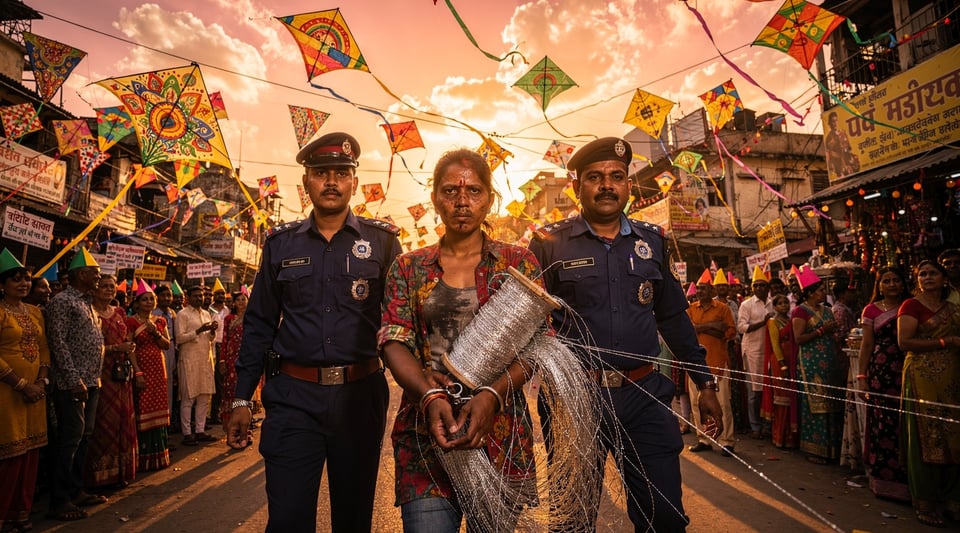
How Manja Went From Thread To Weapon
Kite flying is a beloved tradition across India, especially during Makar Sankranti (January), Uttarayan in Gujarat, and Independence Day (August 15). For generations, kites were flown with simple cotton thread. Over time, competitors began reinforcing their strings with crushed glass powder and, later, synthetic nylon coatings — creating 'manja' that could slice through a rival's kite string in a battle. The problem: these razor-sharp strings don't discriminate between kite threads and human skin, bird wings, or power lines.
EPA, 1986
EPA, 1986
BNS, 2023 §223
BNS, 2023 §223
Injuries Mount During Kite Flying Season
Every year around festival season, emergency rooms fill with patients — motorcyclists whose throats were slashed while riding, children leaning out of car windows, pedestrians caught in fallen strings. These strings also injure birds and cause power outages when they contact electric lines.
States Move To Ban Manja Nationwide
Following a PETA India petition, the National Green Tribunal issued a nationwide interim ban in January 2017. Over subsequent years, more than a dozen state governments — including Delhi, Maharashtra, Punjab, Karnataka, Haryana, Telangana, and Goa — have issued formal notifications under Section 5 of the Environment (Protection) Act, 1986. The Animal Welfare Board of India has urged all remaining states and union territories to follow suit. India's new criminal code, the Bharatiya Nyaya Sanhita 2023, which replaced the Indian Penal Code, added an explicit criminal punishment under Section 223 for disobeying such orders. Despite all of this, illegal manja remains widely sold and used, with enforcement crackdowns typically concentrated around festival seasons.
Where the story gets it wrong
The ban is not limited to festival periods, nor is it a single national law. It is a year-round, permanent prohibition wherever states have issued notifications, applied state-by-state under the EPA, 1986 — some covering only nylon 'Chinese manja,' others extending to all glass- or metal-coated string, including cotton.
The penalty is not merely a small fine. Violations of the Environment (Protection) Act carry up to 5 years' imprisonment and/or a fine of up to ₹1 lakh; Bharatiya Nyaya Sanhita Section 223 adds up to 1 year imprisonment or a ₹5,000 fine for disobeying a duly promulgated order.
The law covers manufacture, sale, and storage of banned manja — not just its use for flying kites. Shopkeepers and distributors who stock or sell prohibited string are equally liable under the state notifications and the Environment (Protection) Act.
State governments, acting under Section 5 of the Environment (Protection) Act, 1986, have issued notifications requiring that 'only cotton thread free from any sharp/metallic/glass components/adhesives/thread strengthening materials' shall be allowed for kite flying. These notifications impose a complete ban on the manufacture, sale, storage, purchase, supply, import, and use of kite flying thread coated with glass, metal, or other sharp materials. Additionally, Section 223 of the Bharatiya Nyaya Sanhita, 2023 (India's replacement criminal code for the IPC) makes use of such prohibited string a punishable offense. Violations of the EPA carry penalties up to five years imprisonment or a fine up to ₹1,00,000 (one lakh rupees), or both. Under BNS Section 223, the offense carries a fine of ₹5,000 or imprisonment up to one year.
- Current status
- Actively Enforced
- Enacted
- January 1, 2017
- Penalty
- Under the Environment (Protection) Act, 1986, Section 15: up to 5 years imprisonment and/or up to ₹1,00,000 (one lakh rupees) fine; continuing violations add ₹5,000/day after conviction. Under the Bharatiya Nyaya Sanhita, 2023, Section 223: up to 1 year imprisonment and/or ₹5,000 fine.Fine: INR5,000 – INR100,000Imprisonment: 5 years
- Jurisdiction
- Implemented via individual state/UT government notifications under Section 5 of the Environment (Protection) Act, 1986. States confirmed with active bans include: Delhi, Maharashtra, Punjab, Karnataka, Goa, Haryana, Himachal Pradesh, Telangana, Tripura, Chandigarh, and Uttar Pradesh (via Allahabad HC order). The National Green Tribunal also issued a nationwide interim order in 2017. The Bharatiya Nyaya Sanhita, 2023, Section 223 provides a national-level criminal overlay.