“Japan Really Does Require Employers to Fight Heat Stroke — But Not With AC”
Japan's Industrial Safety and Health Act genuinely requires employers to implement heatstroke prevention measures during hot conditions, but the law does not specifically mandate air conditioning and does not apply uniformly to all workplaces.
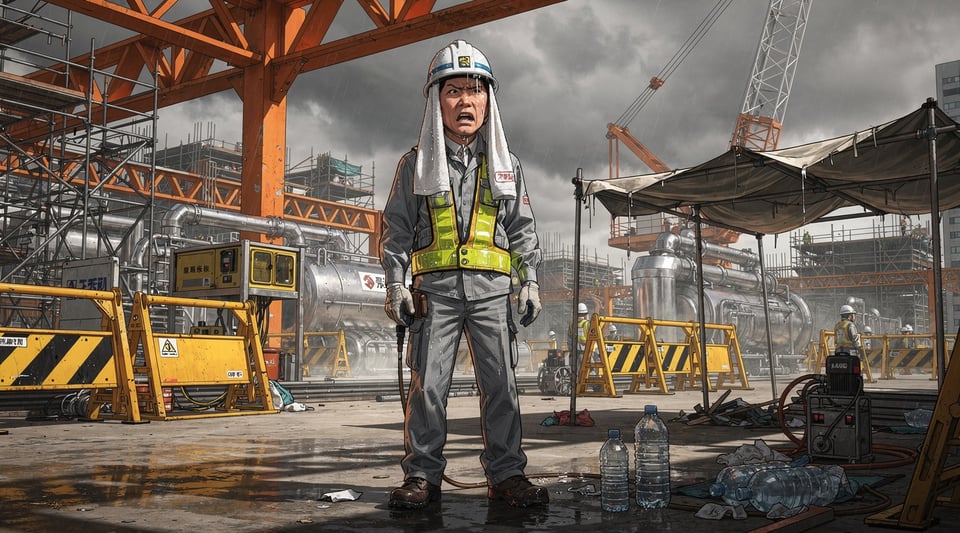
Japan's Deadly Summer Heatstroke Crisis
Japan's summers are ferocious. With humidity-saturated heat regularly pushing apparent temperatures above 40°C, the country has long grappled with occupational heatstroke as a genuine workplace killer. In 2024 alone, 31 workers died and over 1,257 were injured due to workplace heatstroke — the third consecutive year deaths exceeded 30. Construction workers baking on open-air sites and factory hands in un-air-conditioned production halls are disproportionately affected.
From Voluntary Guidelines to Failed Responses
The foundational law — the Industrial Safety and Health Act — has existed since 1972 and has always included a broad duty to prevent heat-related health damage. But for decades, enforcement was relatively soft, relying on voluntary guidelines rather than hard legal mandates with clear penalties. That changed in 2025. Following record-breaking heat and a surge in occupational deaths, Japan's Ministry of Health, Labour and Welfare concluded that vague guidelines were failing workers. Investigations found that many fatal cases resulted not from unpreventable heat, but from delayed detection and botched emergency responses — workers were allowed to 'rest' without cooling treatment, and supervisors failed to call ambulances in time.
New Enforceable Obligations Take Effect
The June 1, 2025 revision to the Ordinance on Industrial Safety and Health created specific, enforceable obligations: designate a responsible person, create a written response plan, and tell all workers about it. Non-compliance now carries fines of up to ¥500,000 and, in cases of serious negligence resulting in death, potential imprisonment.
Why Air Conditioning Isn't Legally Required
The law explicitly does NOT require air conditioning in all workplaces. DLA Piper's legal analysis notes that 'the regulation does not apply to workplaces such as offices where air conditioning is fully installed.' The law targets the workers most at risk — those in factories, construction sites, warehouses, and agricultural settings where AC is impractical or absent. Offices with functioning AC fall outside the regulation's scope.
Where the story gets it wrong
Many assume Japanese law requires installing air conditioning in all workplaces during summer. In fact, the law mandates heatstroke prevention and response measures, not air conditioning specifically — acceptable measures include monitoring, buddy systems, hydration, shade, rest areas, cooling vests, and emergency protocols.
Some assume the law applies equally to every workplace. In fact, it is threshold-triggered and primarily targets high-heat environments like construction sites and factories; air-conditioned offices are generally considered already compliant and fall outside the regulation's primary scope, with AC only mentioned in guidelines as one possible mitigation tool.
Article 22, Item 2 of the Industrial Safety and Health Act requires employers to take necessary measures to prevent health impairments caused by high temperatures. Article 606 of the Enforcement Regulations requires employers to adjust temperature and humidity in indoor workplaces at risk of heat harm. Under the 2025 revision (Article 612-2 of the Enforcement Regulations), employers must: (1) establish a reporting system for workers experiencing heatstroke symptoms; (2) prepare and communicate emergency response procedures including immediate work cessation, body cooling, and medical transport; and (3) inform all workers of these arrangements. These obligations are triggered when work is performed for more than one consecutive hour (or four cumulative hours per day) at a Wet Bulb Globe Temperature (WBGT) of 28°C or higher, or an air temperature of 31°C or higher.
- Current status
- Actively Enforced
- Enacted
- January 1, 1972
- Penalty
- Up to ¥500,000 fine; in cases of serious negligence resulting in worker death or lasting injury, up to 6 months imprisonment. Civil liability for damages may also apply.Fine: up to JPY500,000Imprisonment: 180 days
- Jurisdiction
- National law applicable across all of Japan; enforced by the Ministry of Health, Labour and Welfare and local Labour Standards Inspection Offices.