“In Mexico, Singing the National Anthem Wrong Can Land You a Fine”
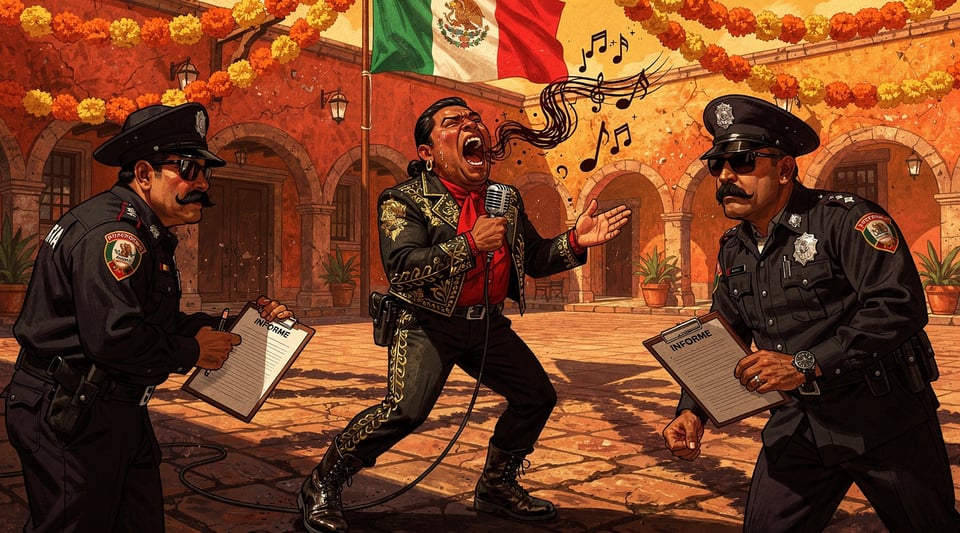
Mexico's federal Law on the National Arms, Flag, and Anthem (1984) explicitly prohibits altering the words or music of the national anthem and performing it without the required solemnity. Violators face fines, up to 36 hours arrest, and in commercial cases, much steeper financial penalties — and the law has genuinely been enforced.
Origins of Mexico's national anthem
Mexico's national anthem has been a source of fierce national pride and controversy since it was first performed in 1854. The lyrics — written by poet Francisco González Bocanegra, reportedly locked in a room by his fiancée until he finished — and the music composed by Spanish-born Jaime Nunó, became an unofficial symbol decades before being codified into law. By 1943, during the presidency of Manuel Ávila Camacho, six of the original ten stanzas were officially removed because they praised figures who had become villains in Mexican memory, including Antonio López de Santa Anna and Emperor Agustín de Iturbide. This edited version became the legally mandated text.
The 1984 law's strict rules
The 1984 Law on the National Arms, Flag, and Anthem formalized strict rules governing how the anthem can be performed, broadcast, and reproduced. Teaching it is mandatory in all primary and secondary schools. The anthem can only be performed at official civic, cultural, scholastic, or sporting events.
Enforcement against Madrigal in 2004
In November 2004, a singer named Madrigal was fined by Mexico's Interior Ministry after she confused the verses of the anthem while performing at a Guadalajara soccer match between Club Deportivo Guadalajara and Monterrey. She apologized publicly, stating she had not done it intentionally. The fine was reduced to approximately $40 USD (400 MXN) after accounting for her economic situation — far below the legal maximum of around $950 USD at the time. Officials said the penalty reflected the government's commitment to ensuring 'the necessary respect that patriotic symbols deserve.'
Danna Paola controversy and 2024 proposal
More recently, in 2024, singer Danna Paola drew criticism for singing the anthem in the wrong musical key (A-flat major instead of the legally mandated key) before a Canelo Álvarez boxing match. A Mexican deputy proposed legislation to dramatically increase penalties, to as much as 2.74 million pesos. The anthem's lyrics include archaic language, multiple stanzas, and a legally fixed musical arrangement.
Where the story gets it wrong
The law is often assumed to fine anyone who simply sings the anthem badly or forgets a word in casual settings. In reality, it targets deliberate alteration, unauthorized commercial performances, and public performances that demonstrate disrespect toward national symbols, particularly by professional performers at official or commercial events. Private, informal, or unintentional errors by ordinary citizens are not the law's focus.
The fine amount is often assumed to be a fixed figure. In reality, it is calculated as a multiple of the daily minimum wage (or UMA), meaning it scales with economic conditions and the severity of the infraction rather than being a flat penalty.
Article 39 of the Ley sobre el Escudo, la Bandera y el Himno Nacionales states: 'It is strictly prohibited to alter the words or music of the national anthem and perform it in whole or in part with compositions or arrangements.' Singing or performing the national anthem for profit without authorization is also prohibited. Article 56 provides that contraventions of the law that imply 'disrespect to the national symbols' shall be punished with a fine of up to 250 times the daily minimum wage (or up to 1,000 times if committed for profit), or arrest for up to 36 hours. Enforcement falls under the Secretaría de Gobernación (Interior Ministry), which weighs the gravity of the infraction, the infractor's intent and economic capacity, and any recidivism.
- Current status
- Rarely Enforced
- Enacted
- February 8, 1984
- Penalty
- Fine up to 250× daily minimum wage (~900,000 MXN / ~$52,000 USD as of 2024 reports), or up to 1,000× minimum wage for for-profit violations (~2.74M MXN); arrest up to 36 hours. In practice, fines have been far lower (e.g., 400 MXN in the 2004 case).Fine: up to MXN900,000Imprisonment: 2 days
- Jurisdiction
- Applies throughout the entire territory of the United Mexican States (Estados Unidos Mexicanos). Enforced by the Secretaría de Gobernación (Interior Ministry).