“Minnesota Pulls the Plug on Crypto Kiosks — But It Wasn't the First State to Do It”
Minnesota banned cryptocurrency kiosks (Bitcoin ATMs) statewide under SF 3868, signed May 5, 2026. All machines had to go offline by August 1, 2026, and be physically removed from public locations by December 31, 2026. Minnesota was the third state to enact a full ban, after Indiana (March 2026) and Tennessee (April 2026) — though it was the first state to regulate kiosks, back in 2024. The law followed 134 scam complaints and nearly $1 million in reported Minnesotan losses over three years.
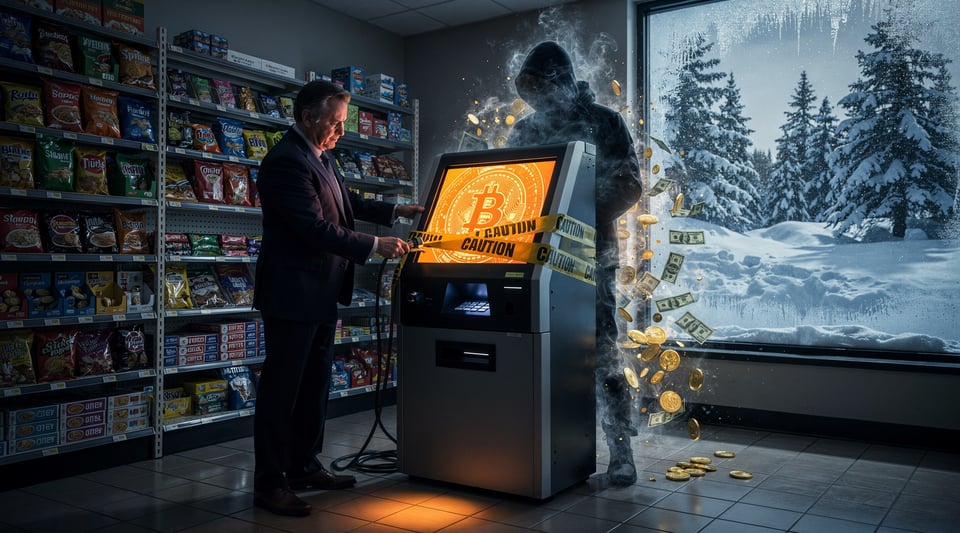
Kiosks became a vehicle for fraud
Cryptocurrency kiosks — ATM-like machines found in gas stations, grocery stores, and convenience stores that convert cash into Bitcoin or other digital currencies — had been multiplying across Minnesota for years. They promised a frictionless on-ramp to crypto, but quickly became a notorious tool of fraud. Scammers would impersonate government officials, law enforcement, or family members in distress, pressuring victims to withdraw cash and feed it into a nearby kiosk, instantly converting it into untraceable cryptocurrency sent overseas.
2023-2025
2023-2025
2025
2025
The scale of reported losses
Minnesota's Department of Commerce recorded 134 crypto kiosk scam complaints between 2023 and 2025, with losses nearing $1 million. In 2025 alone, 70 cases were reported with over $540,000 lost, averaging nearly $6,800 per transaction. Older adults were disproportionately targeted.
From light regulation to outright ban
Minnesota tried a lighter-touch approach first: in 2024 it became the first state in the nation to regulate kiosks, requiring warning signs, transaction limits, and refunds for new customers. But scammers adapted quickly and the fraud continued unabated. In 2026, lawmakers from both parties had seen enough. The ban bill passed the House 127–7 and sailed through the Senate with similarly overwhelming margins. Gov. Tim Walz signed SF 3868 on May 5, 2026.
Minnesota trailed other states on timing
Minnesota was not first to enact such a ban, however — Indiana outlawed kiosks in March 2026 and Tennessee followed in April 2026, both preceding Minnesota's signing. With roughly 201–350 licensed kiosks operating across the state, the ban only covers the physical kiosks — Minnesotans can still buy and sell cryptocurrency through regulated online platforms.
Where the story gets it wrong
Some coverage calls these machines 'crypto ATMs,' but Minnesota's law (and state regulators) refer to them as virtual currency kiosks — unlike a bank ATM, they let users buy or exchange cryptocurrency with cash, a debit card, or a digital wallet, but they don't dispense cash.
It's also not an instant, blanket shutdown: the operating ban starts August 1, 2026, while kiosk operators have until December 31, 2026 to remove machines or provide affected customers a payout.
Minnesota Statutes § 53B.751 (Virtual Currency Kiosks; Prohibition), enacted via Laws of Minnesota 2026, chapter 65, section 2, from Senate File 3868 (94th Legislature, 2025–2026 session). Signed into law May 5, 2026; effective August 1, 2026. Kiosk operators must remove any kiosk visible or accessible to the public, or issue the required customer payout, by December 31, 2026.
- Current status
- Actively Enforced
- Enacted
- May 5, 2026
- Penalty
- Civil penalties and legal sanctions enforceable by the Minnesota Department of Commerce against operators continuing to offer kiosk transactions after August 1, 2026. Specific fine amounts subject to Commerce Department enforcement action.
- Jurisdiction
- Applies statewide across Minnesota. Does not affect other U.S. states or federal crypto regulation.