“Morocco Requires Arabic on Product Labels and Price Displays”
Morocco's Law No. 31-08 on Consumer Protection requires suppliers to inform consumers by marking, labelling and display, and its implementing decree makes Arabic the language of the mandatory label mentions, with foreign languages permitted alongside rather than instead. Breaching those consumer-information rules is punished by a fine of MAD 2,000-5,000 under article 173, not by the six-figure penalties the claim usually carries.
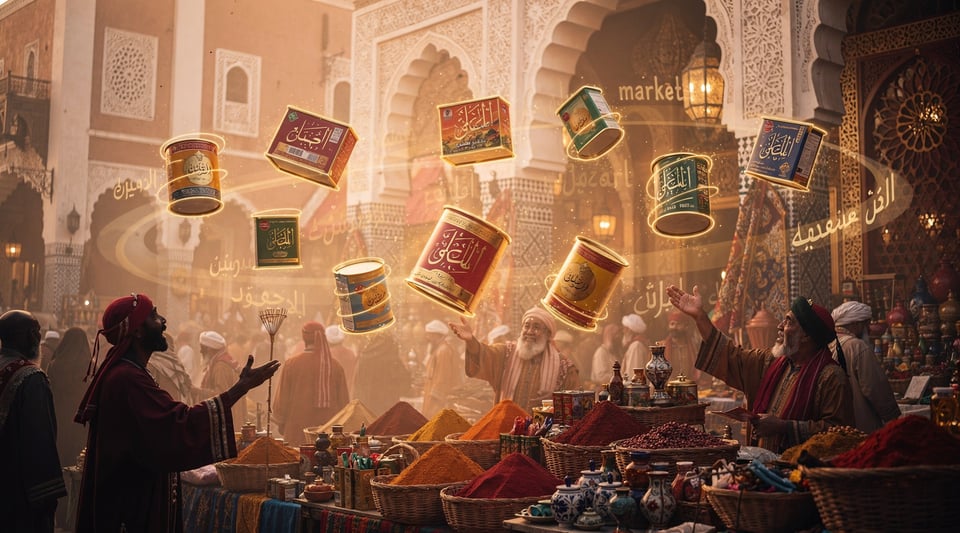
Roots in post-independence Arabization
Morocco's Arabic-first labelling requirement is rooted in the country's post-independence 'Arabization' policy, a decades-long effort to reassert Arabic as the language of state and commerce after 44 years of French and Spanish colonial rule. When France withdrew in 1956, Moroccan authorities began systematically replacing French in official life - but French persisted stubbornly in business, education, and government.
Law No. 31-08 formalizes the requirement
By 2011, Law No. 31-08 formalized consumer protection standards. Article 3 obliges every supplier to inform the consumer by marking, labelling or display, and leaves the modalities to regulation; article 6 requires every product offered for sale to carry a label whose content and form are fixed by regulation. Decree No. 2-12-503 of 11 September 2013 supplies that content, making Arabic the language of the mandatory mentions. Article 206 separately requires any instrument drawn up in a foreign language to be accompanied by an Arabic translation.
The penalty is modest, not ruinous
Article 173 punishes breaches of Title II - the consumer-information title that holds the labelling and price rules - and of the texts made for its application with a fine of 2,000 to 5,000 dirhams, roughly 200 to 500 US dollars. The million-dirham ceiling that circulates with this claim comes from elsewhere in the same law: articles 174, 180 and 184 fine a corporate offender 50,000 to 1,000,000 dirhams for misleading advertising, doorstep selling and abuse of a consumer's weakness respectively.
Enforcement remains inconsistent
Enforcement has historically been patchy - one consumer protection advocate noted that only around 4,000 infractions are registered annually against more than 800,000 commercial points of sale. Bilingual Arabic-French displays are the norm in urban centres like Casablanca and Rabat, not Arabic-only ones. The law was amended in 2020 by Law No. 78-20, primarily adjusting jurisdictional competence for consumer disputes; the Arabic labelling requirement remains in force.
Where the story gets it wrong
Some assume the law requires prices or labels to appear 'in Arabic only,' with Arabic replacing other languages. In fact, Arabic must be present on the mandatory label mentions and consumer documents, but French and other languages may appear alongside it - bilingual Arabic-French labelling is standard practice in Moroccan commerce.
Another misconception holds that price numerals themselves must be written in Arabic script. The price-display requirement actually concerns expressing prices in Moroccan dirhams rather than a foreign currency, not the language or script used for the numerals.
The 'fines up to a million dirhams' figure attached to this claim is borrowed from the wrong articles. Law 31-08 does fine corporate offenders MAD 50,000-1,000,000, but only for misleading or comparative advertising (art. 174), doorstep and unsolicited selling (art. 180) and abuse of a consumer's weakness or ignorance (art. 184). Breaching the labelling and price-information rules of Title II is punished under art. 173 by a fine of MAD 2,000-5,000.
- Current status
- Rarely Enforced
- Enacted
- February 18, 2011
- Penalty
- MAD 2,000-5,000 fine (Law 31-08 art. 173, for breaches of Title II - consumer information, labelling and price indication - and of its implementing texts)Fine: MAD2,000 – MAD5,000
- Jurisdiction
- National law applicable across the Kingdom of Morocco