“Netherlands Cities Fine Homeless People for Sleeping Rough — But Policies Are Rapidly Changing”
Many Dutch municipalities include a ban on sleeping in public spaces in their General Local Ordinance (APV), under which homeless individuals can be — and regularly have been — fined. However, a growing number of cities are repealing or suspending enforcement of these provisions amid fierce public debate and legal challenges.
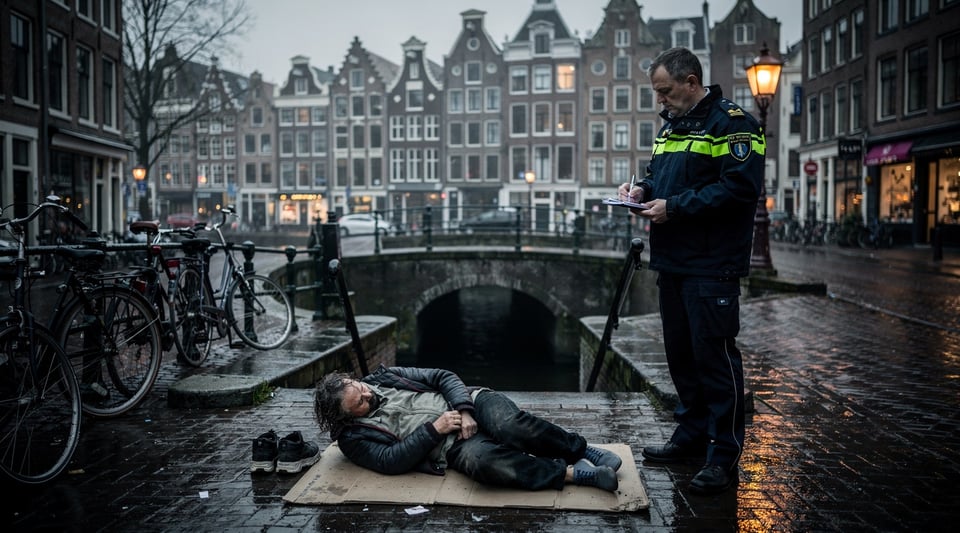
Legal basis for the sleeping ban
Dutch municipalities derive their authority to regulate public spaces from the Gemeentewet (Municipal Act) and adopt their own Algemene Plaatselijke Verordening (APV) — a local public-order bylaw — typically modelled on a template published by the Vereniging van Nederlandse Gemeenten (VNG, the Association of Dutch Municipalities). Most APVs historically included a ban on using public spaces as sleeping places, primarily aimed at preventing urban 'decay', wild camping by tourists, and public-nuisance situations. In practice, however, these provisions have been applied broadly against rough-sleeping homeless people.
Scale of fines issued nationally
Research by political economist Merel van Rooy found that roughly 2,170 'homeless fines' were issued across 130 Dutch municipalities in a single year, averaging six per day and totalling over €300,000. The enforcement picture is starkly uneven and contested. Amsterdam handed out approximately 1,800 fines between 2021 and 2024 despite internal policies discouraging it.
Cities reverse course amid legal pressure
In June 2025, Amsterdam's mayor Femke Halsema announced the city would cease fining rough sleepers entirely, calling the measure counterproductive as unpaid fines simply accumulate and drive people deeper into debt. Leiden, Almere, and Maastricht have taken similar steps, while Rotterdam — by far the biggest issuer of fines — saw a 13% year-on-year increase even as other cities wound down. In February 2026, a Dutch court ruled it was disproportionate and arbitrary to prosecute a homeless Romanian man found sleeping under a bridge in Utrecht; weeks later, on 27 February 2026, the Utrecht city council voted to end the outdoor-sleeping fines there too. A UN committee has also called on the Netherlands to end criminalisation-based responses to homelessness. The VNG's summer 2024 model-APV update explicitly cautions that 'it makes little sense to fine homeless people who are forced to sleep outside.'
Where the story gets it wrong
The claim is often stated as if it is a uniform national law — it is not. There is no single national statute banning rough sleeping; instead, the ban exists at the municipal level via individual APVs, and inclusion is optional. Not all municipalities include it, and several have recently repealed or suspended it.
The rule is often assumed to have been written specifically to target homeless people. In fact, it was originally intended to address public nuisance and wild camping by tourists, and only later came to be applied broadly against people sleeping rough.
Enforcement is assumed to be uniform across the country, but it is highly inconsistent: some cities issue hundreds of fines annually while others operate near-zero enforcement policies. Fines are also often uncollectable, since homeless individuals rarely have the means to pay, causing debts to escalate rather than being resolved.
Algemene plaatselijke verordening Utrecht 2010, artikel 2:31 — Liggen of slapen op of aan een openbare plaats: "Het is verboden –al dan niet met gebruikmaking van enige vorm van beschutting, waaronder in ieder geval begrepen het gebruik van een auto, of caravan e.d.– op of aan een openbare plaats: a. tussen zonsondergang en zonsopgang te liggen of te slapen; b. tussen zonsopgang en zonsondergang te liggen of te slapen, nadat door een opsporingsambtenaar in het belang van de openbare orde, veiligheid of ter bestrijding van overlast is aangezegd dat dit moet worden beëindigd."
- Current status
- Actively Enforced
- Penalty
- Administrative fine (bestuurlijke boete) or criminal penalty notice (strafbeschikking); typically up to €415 per offence for a natural person. Fines may escalate substantially if unpaid, via the CJIB (Central Fine Collection Agency). In practice, a warning is often issued first; fines are supposed to follow only upon repeat offence or serious nuisance.
- Jurisdiction
- Applies municipality by municipality through the APV (Algemene Plaatselijke Verordening), and the article number differs from city to city: the VNG model-APV numbers it 2:54 (a facultative article added in the summer 2024 model update), while Utrecht's APV 2010 numbers the equivalent prohibition 2:31. Still on the books in Rotterdam, Den Haag, Westland, Vlaardingen and many smaller municipalities. Amsterdam, Leiden, Almere and Maastricht have repealed the provision or stopped enforcing it, and Utrecht joined them on 27 February 2026 when its council voted to strike the ban from the APV and the city stopped issuing fines — although the consolidated Utrecht APV in the official register still carried article 2:31 in the version in force from 2 February 2026 when checked on 31 August 2026. The VNG model-APV retains the provision as a facultative (optional) article.