“In the Philippines, Annoying Someone Is a Literal Crime”
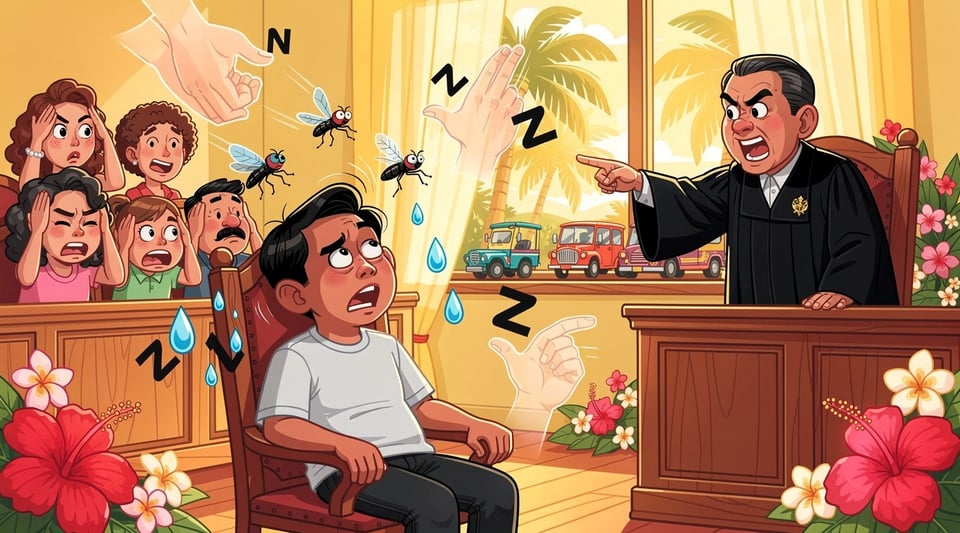
Under Article 287 of the Philippines' 1930 Revised Penal Code, 'unjust vexation' is a criminal offense covering any human conduct that causes annoyance, irritation, torment, or distress to another person — even without physical contact or financial harm. You can go to jail for being a nuisance.
How the catch-all provision began
When the Philippines codified its criminal law in 1930 — drawing heavily on Spanish law and early American colonial statutes — legislators included a broad 'catch-all' provision under the heading of 'Light Coercions.' The idea was to fill the gaps: if someone's conduct was genuinely harmful to another person's peace of mind but didn't neatly fit theft, assault, threats, or any other defined crime, Article 287's second paragraph could step in.
Broad court application draws criticism
Courts have applied it to a wide variety of acts: constructing a barbed wire fence in front of a chapel during a religious ceremony to spite attendees; abruptly cutting a business's electricity and water lines during peak hours; and even lightly pinching someone's arm without injury. The law's critics — including law professors and a House bill by Rep. Jaime Fresnedi — have called it a 'catch-all crime' and a due process nightmare, arguing citizens cannot be expected to avoid conduct that is never explicitly defined in the statute.
A failed attempt to redefine it
The late Senator Miriam Defensor-Santiago attempted to fix this by filing a Senate bill that would have added a standalone Article 287-A with an actual definition — 'a course of conduct directed at a specific person that causes substantial emotional distress and serves no legitimate purpose' — and stiffer penalties. The bill was never enacted.
How cases are handled today
In practice, most unjust vexation cases are resolved at the barangay (village) level through mediation. The offense has a short prescription period of only two months, and only the offended party (not the state) can initiate charges. Despite calls for abolition, the law remains active as of 2026, and Philippine courts continue to decide cases under it.
Where the story gets it wrong
Many Filipinos — and nearly all foreign commentators — describe unjust vexation as 'a law against being annoying,' which is partially accurate but misleading. The law is NOT triggered by mere rudeness or accidental irritation. Malice must be proven: the offender must have intended to annoy or harass without legal justification. Good faith is a complete defense.
The offense is also frequently confused with graver offenses like grave coercion or acts of lasciviousness — courts regularly clarify that unjust vexation applies only when the conduct does not fall under a more specific law.
Many sources online still cite the original penalty of a ₱5–₱200 fine for unjust vexation, but that figure is outdated. A 2017 amendment (Republic Act No. 10951) raised the fines significantly, to a range of ₱1,000 to ₱40,000.
Article 287, paragraph 2 of the Revised Penal Code (Act No. 3815) states: 'Any other coercions or unjust vexations shall be punished by arresto menor or a fine ranging from [₱1,000] to not more than [₱40,000], or both.' (Fine amounts updated by Republic Act No. 10951 in 2017 from the original ₱5–₱200 range.) The Supreme Court has defined unjust vexation as 'any human conduct which, although not productive of some physical or material harm, would unjustly annoy or irritate an innocent person' (Maderazo v. People, 2006). Malice must be proven — good faith is a valid defense.
- Current status
- Actively Enforced
- Enacted
- December 8, 1930
- Penalty
- Arresto menor (imprisonment of 1 to 30 days) and/or a fine of ₱1,000 to ₱40,000 (as amended by R.A. 10951 in 2017). Community service may substitute for imprisonment under R.A. 11362 (2019).Fine: PHP1,000 – PHP40,000Imprisonment: 30 days
- Jurisdiction
- Applies nationwide across the Republic of the Philippines. Light offenses are typically processed first at the barangay (local community) level under Katarungang Pambarangay Law before escalating to prosecutors.