
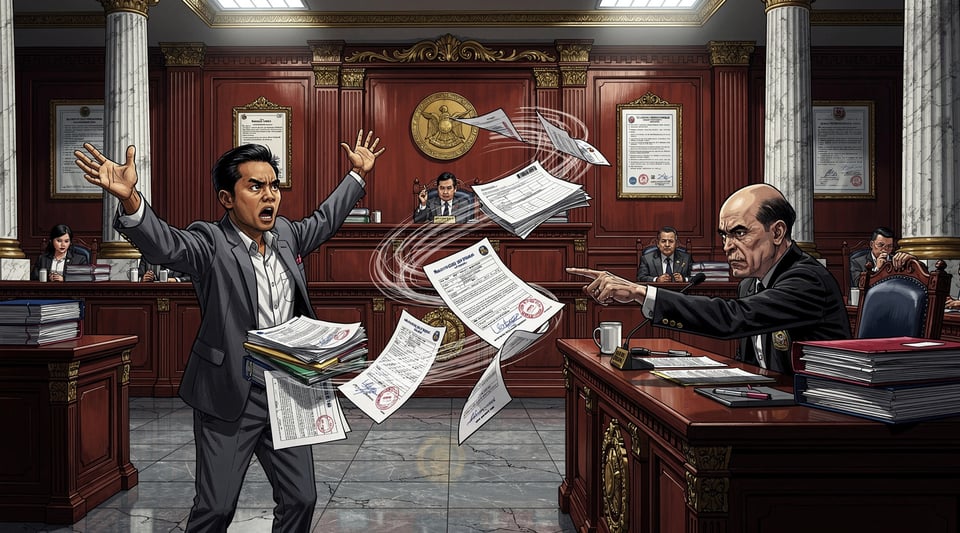
In the Philippines, Annoying Someone Can Be a Criminal Offense
The Short Answer
The Philippines' Revised Penal Code includes 'unjust vexation' as a criminal offense under Article 287 — making it illegal to intentionally annoy or irritate another person without lawful justification. It carries up to 30 days imprisonment and fines up to ₱40,000, but requires proof of malicious intent.
The Full Story
When the Philippines codified its criminal law in 1930 under Act No. 3815 — the Revised Penal Code — it inherited a Spanish colonial legal tradition that prized social harmony and personal dignity. Article 287 was designed to fill gaps in the penal code by catching low-level but genuinely harmful conduct that didn't rise to the level of graver offenses like coercion or threats. The idea was that the state, not private individuals, should be the enforcer of social order — meaning you can't simply take the law into your own hands to retaliate against a neighbor or pest.
For decades the offense carried laughably outdated fines (₱5 to ₱200, set in the 1930s), which critics argued made it toothless. In 2017, Republic Act 10951 modernized the fines to a range of ₱1,000 to ₱40,000. Real cases have been colorful: engineering students were arrested in Cebu for flashing a rude finger gesture toward police officers during the Sinulog festival; people have been charged for disconnecting a neighbor's utilities, for public embracing and kissing without consent, and for obstructing a chapel with a barbed-wire fence. Online harassment and persistent unwanted messages may also qualify.
The law remains controversial. The late Senator Miriam Defensor-Santiago attempted to sharpen its definition, proposing a clearer 'course of conduct' standard. More recently, Congressman Jaime Fresnedi of Muntinlupa filed House Bill 10510 to abolish the provision entirely, arguing it is a 'catch-all crime' whose scope is unfairly defined by the complainant's feelings. As of mid-2026, the bill has not passed; Article 287 remains on the books and is actively enforced.
Common Misconceptions
The claim is often stated as 'you can be arrested simply for annoying someone' — which is an oversimplification. The law requires proof of malicious intent (dolo): accidental or good-faith conduct that happens to annoy someone does not qualify. The prosecution must demonstrate that the offender acted without lawful justification and with the purpose of causing annoyance, irritation, or distress. It is also classified as a 'light felony,' the least serious category in Philippine criminal law, and many cases are resolved through barangay-level mediation before ever reaching a court.
Actual Legal Text
Article 287 (Light Coercions), Revised Penal Code (Act No. 3815, as amended by R.A. 10951): 'Any other coercions or unjust vexations shall be punished by arresto menor or a fine ranging from One thousand pesos (₱1,000) to not more than Forty thousand pesos (₱40,000), or both.' The Supreme Court has defined unjust vexation as 'any human conduct which, although not productive of some physical or material harm, would unjustly annoy or irritate an innocent person' (Maderazo v. People, 2006; Baleros Jr. v. People, 2007).
Current Status
Actively Enforced
Penalty
Arresto menor: imprisonment of 1 to 30 days, and/or a fine of ₱1,000 to ₱40,000 (as updated by R.A. 10951 in 2017). Court has discretion to impose imprisonment, fine, or both.
Fine: PHP1,000 – PHP40,000
Imprisonment: 30 days
Last Verified
June 12, 2026
Enacted
December 8, 1930
Jurisdiction Notes
National law — applies throughout the Republic of the Philippines under the Revised Penal Code (Act No. 3815). Prosecuted in Municipal Trial Courts or Metropolitan Trial Courts.