“Russia Bans Numbers, Profanity & Titles as Baby Names — But NOT 'Offensive' Ones”
Russia does have a federal law restricting what parents can name their children, but it targets numbers, symbols, obscene language, and official titles/ranks — not names deemed offensive to national dignity or historical figures, as the claim suggests.
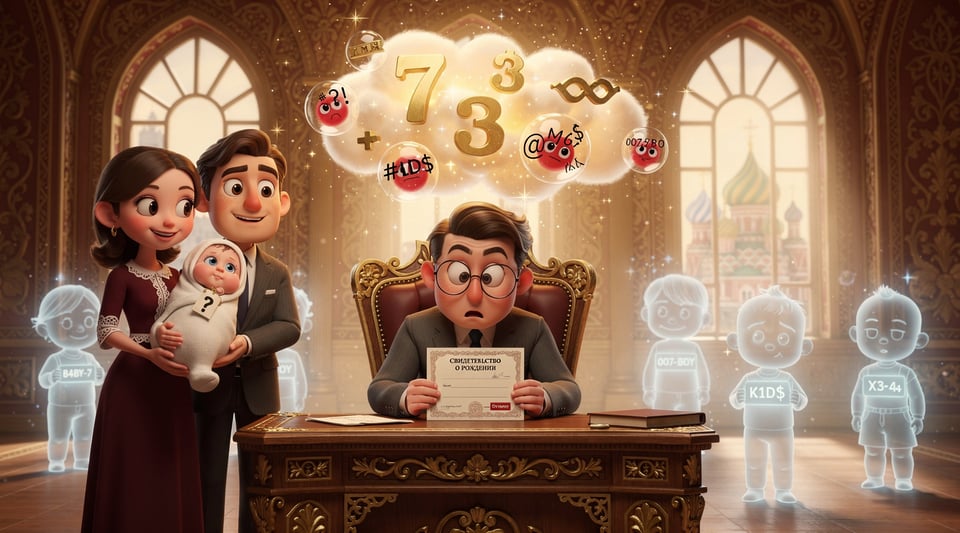
Decades of eccentric naming traditions
Russia's naming law has a colorful backstory rooted in decades of eccentric naming. During the Soviet era, parents gave children revolutionary names like 'Vladlen' (from Vladimir Lenin), 'Oktyabrina' (after the October Revolution), and 'Mels' (an acronym of Marx, Engels, Lenin, Stalin). Post-Soviet Russia then saw a wave of parents naming children after luxury brands, animals, and even alphanumeric codes.
The case that prompted legislation
The case that crystallised calls for legislation was that of a boy registered as 'БОЧ рВФ 260602' — meaning 'biological human object of the Voronin-Frolov family born on June 26, 2002.' Moscow's civil registry refused to register the name, courts upheld the ban, and the child spent years without valid identity documents. Russian lawmakers also cited names like 'Air Traffic Controller,' 'Lexus,' 'Lettuce,' 'Princess Daniella,' and 'Dolphin' as evidence the system needed reform.
Stated rationale and later proposals
The legislation's stated rationale was protecting children from bullying and safeguarding their dignity — not protecting national symbols or historical figures. In 2025, further proposals emerged to introduce an approved name list and ban gender-opposite names, but these had not been enacted as of early 2026. The 'national dignity and historical figures' framing appears to be a distortion of the law that has circulated in 'weird laws' listicles online.
Where the story gets it wrong
Some claim Russia bans baby names deemed offensive to national dignity or historical figures. In fact, the 2017 law is narrower: it bans non-letter characters, profanity, and official titles or ranks. Politically charged names like 'Putin' or 'Stalin,' which parents have actually used, are not prohibited.
Some sources conflate a 2025 legislative proposal for an approved-names list with the existing 2017 law banning certain names. These are separate: the 2025 proposal had not passed as of mid-2026, unlike the enacted 2017 amendment.
Federal Law No. 94-FZ of May 1, 2017, amending Article 58 of the Family Code of the Russian Federation (Federal Law No. 223-FZ), prohibits parents from giving children names that contain: numerals, alphanumeric combinations, symbols or non-letter characters (except a hyphen), obscene or profane words, and indications of official ranks, positions, or titles. There is no provision banning names on grounds of offense to 'national dignity' or 'historical figures.'
- Current status
- Actively Enforced
- Enacted
- May 1, 2017
- Penalty
- Registration refusal: the ZAGS (civil registry office) is required to refuse to register a prohibited name. No monetary fine or imprisonment; the practical consequence is the child cannot receive a birth certificate or identity documents until a compliant name is provided.
- Jurisdiction
- Applies nationally across the Russian Federation via amendment to the federal Family Code.