“Saudi Arabia's War on Valentine's Day: Red Roses Were Contraband”
For decades, Saudi Arabia's religious police banned the sale of red roses, heart-shaped gifts, and all Valentine's Day paraphernalia around February 14. The enforcement regime effectively collapsed in 2016 — not 2018 — when a royal decree stripped the religious police of their arrest powers.
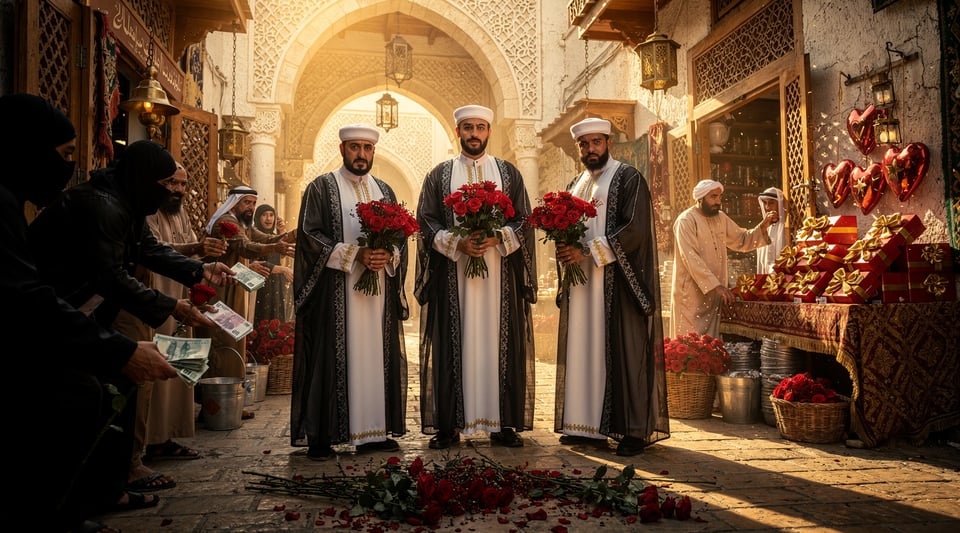
Religious police enforce the annual ban
For decades, Valentine's Day was effectively outlawed in Saudi Arabia — not by a single act of parliament, but through the sweeping authority of the Committee for the Promotion of Virtue and Prevention of Vice (CPVPV), known colloquially as the 'religious police' or mutawa. Rooted in Saudi Arabia's strict Wahhabi interpretation of Islam, the CPVPV viewed Valentine's Day as a Western Christian import that promoted immoral mixing between unrelated men and women. Each year in the days before February 14, religious police officers would descend on florists and gift shops across cities like Riyadh and Jeddah, handing out printed decrees ordering the removal of all red items — roses, ribbons, gift boxes, and teddy bears. Shop owners who refused risked having their stores raided and shuttered. A thriving black market emerged: florists smuggled red roses at up to six times their normal price, delivering bouquets in the dead of night to avoid detection. One Riyadh resident recalled that even wearing red clothing around Valentine's Day could attract the religious police's attention.
2016 decree strips religious police's power
The turning point came on April 11, 2016, when a Saudi Cabinet royal decree — part of Crown Prince Mohammed bin Salman's Vision 2030 modernization reforms — stripped the CPVPV of its powers to pursue, arrest, detain, or interrogate anyone. By 2018, the former head of the religious police publicly declared that celebrating love was not against Islamic teachings, and Valentine's Day celebrations became truly open. Flower prices plummeted, restaurants hosted romantic dinners, and Saudi newspapers published Valentine's Day dining guides — a transformation that would have been unimaginable just a few years earlier.
Where the story gets it wrong
The claim states the ban lasted 'until 2018,' but the critical legal turning point was 2016, when a royal decree stripped Saudi Arabia's religious police of their enforcement powers. Public celebrations became visibly common from 2017–2018 onward, but the underlying law had already changed two years earlier.
There was never a single, formal 'Valentine's Day Ban Law' to repeal — enforcement ran through annual religious police fatwas and administrative decrees rather than a codified statute. What changed in 2016 wasn't a repeal but the removal of the CPVPV's power to arrest and detain.
The ban was not absolute: private celebrations between married couples were generally tolerated. The crackdown targeted the commercial sale of Valentine's Day items — red roses, heart-shaped gifts, and similar paraphernalia — and public displays of affection, not private observance of the holiday.
No single codified statute exists. Enforcement came through fatwas (religious decrees) issued by the Commission for the Promotion of Virtue and Prevention of Vice (CPVPV), backed by royal directives. Decrees ordered florists and gift shops to remove all red-colored items — including roses, wrapping paper, teddy bears, and heart-shaped goods — in the days leading up to February 14 each year. Violations could result in store closure, confiscation of goods, and arrest of shop owners. The CPVPV's enforcement powers were curtailed by a Saudi Cabinet royal decree issued on April 11, 2016.
- Current status
- Repealed
- Enacted
- January 1, 2000
- Repealed
- April 11, 2016
- Penalty
- Confiscation of Valentine's goods, fines and potential closure of shops, arrest of violators. Black market roses sold at up to 6x normal price (approx. 30 Saudi riyal vs. standard 5 riyal).
- Jurisdiction
- Applied nationwide across Saudi Arabia, enforced by the national CPVPV (religious police). Enforcement was stricter in conservative areas like Riyadh and more loosely observed in cosmopolitan Jeddah.