“South Africa Bans Car Washing & Lawn Watering During Drought — But Not With R1M Fines”
South Africa genuinely prohibits using municipal drinking water for car washing and lawn/garden irrigation during drought-triggered water restrictions, and violators can be fined. However, the widely cited 'up to 1 million rand' fine significantly overstates what typical residential or commercial offenders face — spot fines start at R1,000, with prosecution leading to up to R10,000–R12,000 for repeat offenders under municipal by-laws.
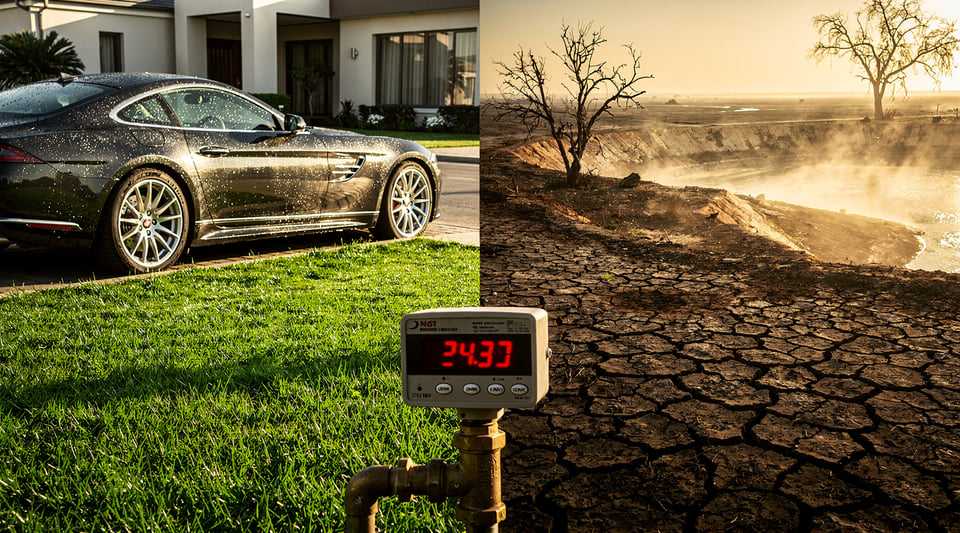
South Africa's Water Scarcity and Day Zero
South Africa is a genuinely water-scarce country, receiving roughly half the global average annual rainfall. The situation became globally infamous during the 2015–2020 Cape Town water crisis, when dam levels plummeted to near-historic lows and the city came terrifyingly close to 'Day Zero' — the point at which municipal taps would have been switched off entirely, an event that would have made Cape Town the first major city in the world to run out of water.
Tiered Restrictions Ban Car Washing and Watering
To avert this disaster, the City of Cape Town implemented a tiered system of water restrictions (Levels 1 through 6B), each progressively banning more activities. At Level 4B and above, car washing with municipal water was completely banned — vehicles had to be cleaned with waterless products or grey water. Garden watering with potable water was similarly banned, with only limited use of greywater, borehole water, or harvested rainwater permitted during restricted time windows.
Enforcement Through Inspectors and Spot Fines
Enforcement was real and visible: water inspectors patrolled neighbourhoods, the public was encouraged to report violators, and spot fines were issued. Notably, wealthy neighbourhoods were identified as the worst offenders. During the peak crisis, those exceeding their 50-litre daily per-capita allowance faced fines of between R500 and R3,000.
Origin of the R1 Million Myth
The 'R1 million fine' figure likely originates from conflating municipal bylaw penalties with the much higher penalties available under the National Water Act or National Environmental Management Act for serious industrial or pollution-related water offences, which can reach R5–10 million. This number then spread through news coverage and 'weird laws' listicles, becoming attached to the more relatable car-washing prohibition. The restrictions remain on the books — as recently as late 2025, towns across the Western Cape were placed under Level 4–6 restrictions ahead of summer.
Where the story gets it wrong
Misconception: violators can be fined up to R1 million. Reality: residential and commercial water-restriction offences carry spot fines of R1,000–R12,000 under municipal by-laws, with repeat offenders facing up to R10,000 in fines. Million-rand penalties exist only under the National Water Act and NEMA, for serious industrial water misuse or pollution — not domestic car washing.
Misconception: the restrictions are a permanent, blanket national law. Reality: they are activated by municipalities or the national Department of Water and Sanitation when drought conditions cross specific thresholds, with the severity of what is banned depending on the restriction level declared.
Misconception: all water use for car washing or gardening is banned during restrictions. Reality: grey water, borehole water, or harvested rainwater remains generally permitted even during high-level restrictions, provided the source is registered and signposted.
- Current status
- Actively Enforced
- Enacted
- January 1, 1998
- Penalty
- Spot fine of R1,000–R12,000 for municipal water restriction violations (car washing, lawn watering). Repeat offenders prosecuted under the City of Cape Town Water By-Law face fines up to R10,000 or imprisonment up to 6 months or both. Serious industrial/pollution offences under the National Water Act or NEMA can attract fines of R5–10 million and/or up to 10 years' imprisonment. The claimed 'R1 million' fine does not apply to typical drought restriction violations.Fine: ZAR1,000 – ZAR10,000Imprisonment: 180 days
- Jurisdiction
- The National Water Act 36 of 1998 provides the national framework; specific restriction measures and associated fines are implemented at municipal level via by-laws and provincial government gazette notices. The City of Cape Town's Water By-Law 2010 (as amended 2018) is the most documented example, but similar frameworks apply across South African municipalities.