“Sweden Makes Parents Get Government Approval Before Naming Their Baby”
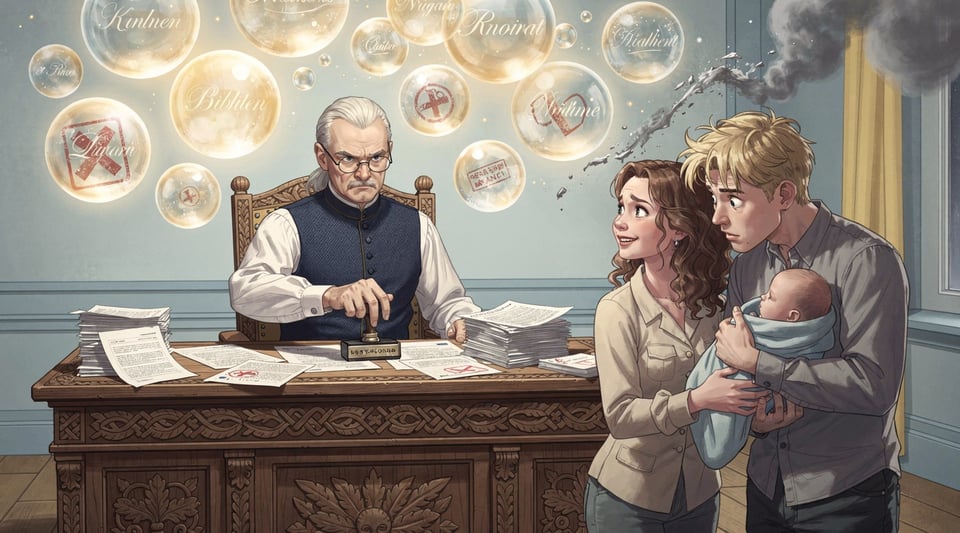
Sweden requires all parents to submit their child's proposed name to a government agency for approval within three months of birth. Names that could cause offence or discomfort to the bearer are rejected — as famously demonstrated when the 43-character name 'Brfxxccxxmnpcccclllmmnprxvclmnckssqlbb11116' was denied by a district court.
History of Sweden's Naming Law
Sweden's tradition of regulating names stretches back to the Name Ordinance of 5 December 1901, which was initially created to prevent non-noble families from appropriating the names of noble families. The law was revised numerous times — in 1919, 1920, 1921, 1922, 1931, 1946, and 1962 — before being replaced by the Names Act of 1963, then again by the Namnlagen (Names Act of 1982). The most current version, Lag om personnamn (SFS 2016:1013), was adopted by the Riksdag on 9 November 2016, formally issued (utfärdad) on 17 November 2016, and entered into force on 1 July 2017, with the stated purpose of making name law clearer while giving Swedes somewhat more freedom in choosing names.
The 43-Character Protest Name
The most infamous test case of this law is that of 'Brfxxccxxmnpcccclllmmnprxvclmnckssqlbb11116' — a 43-character string of consonants and numbers, ostensibly pronounced 'Albin'. The child was born in 1991 to parents Elisabeth Hallin and Lasse Diding, who were philosophically opposed to the naming law and deliberately refused to register any name. When the boy turned five, a district court in Halmstad fined the parents 5,000 kronor (roughly US$740 at the time) for the failure to register. In protest, the parents submitted the bizarre 43-character name in May 1996, describing it as 'a pregnant, expressionistic development that we see as an artistic creation' to be understood in the spirit of 'pataphysics — a parody of science. The court swiftly rejected it and upheld the fine. The parents then tried to go in the opposite direction, submitting just the single letter 'A' (also pronounced 'Albin'), but were rejected again because one-letter names are also prohibited.
Other Rejected Names and Later Reforms
Other rejected names in Sweden include Superman, Veranda, IKEA, and 'Allah' (rejected in 2009 on the basis that it could be seen as objectionable for religious reasons). The 2017 revision did liberalise some aspects — for instance, removing limits on how many times a person may change their name — while keeping the core protective restrictions in place.
Where the story gets it wrong
Many sources still cite the 1982 Names Act (Namnlagen, SFS 1982:670) as the operative law; in fact it was replaced by SFS 2016:1013, which came into force on 1 July 2017.
Some accounts claim 'Brfxxccxxmnpcccclllmmnprxvclmnckssqlbb11116' was the name given to the child at birth. In reality, it was submitted as a protest name after the parents were fined for failing to register any name by the boy's fifth birthday, and was never the child's actual registered name.
Some accounts also state that names are 'banned' outright, or that the government assigns a name itself. In fact, names are simply not approved — parents can keep submitting alternatives until one is accepted — and the government can only reject unsuitable names, not choose one.
- Current status
- Actively Enforced
- Enacted
- July 1, 2017
- Penalty
- Parents who fail to register an approved name within three months of birth may be fined. In the landmark 1996 Halmstad case, the court imposed a fine of 5,000 Swedish kronor for failure to register a name by the child's fifth birthday.Fine: up to SEK5,000
- Jurisdiction
- National law applying to all of Sweden, administered by the Swedish Tax Agency (Skatteverket).