“Tajikistan Bans 'Alien' Clothing — Hijabs AND Miniskirts Outlawed by Same Law”
Tajikistan has enacted national legislation banning clothing deemed 'alien to national culture' — including both Islamic dress (hijabs, veils) and Western-style garments (miniskirts, tight-fitting clothes) — in public places, government buildings, and educational institutions. Citizens are legally obligated to wear national Tajik dress instead.
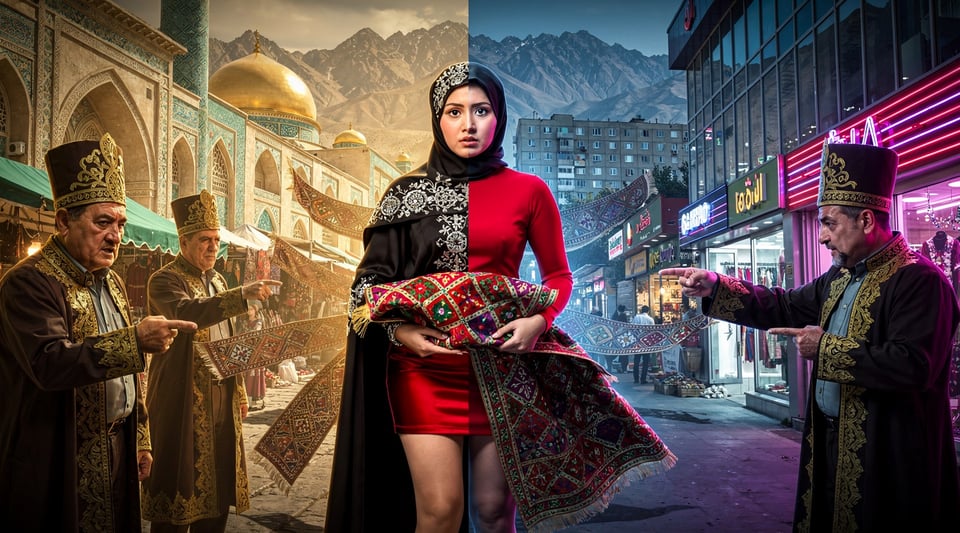
Origins of the unofficial ban
Tajikistan's dress code crackdown is one of the most sweeping clothing-regulation campaigns in the world — and it targets both ends of the fashion spectrum simultaneously. The story begins in 2007, when the Education Ministry first banned Islamic clothing AND Western-style miniskirts for students, framing both as 'foreign' influences incompatible with Tajik national identity. This was largely unofficial for years: local task forces enforced it, police raided markets, and women were turned away from hospitals and government offices for wearing hijabs — yet no formal law existed.
Rahmon's push for national dress
President Emomali Rahmon, who has ruled since the mid-1990s following the 1992–1997 civil war, has consistently framed both Islamic dress (associated with Arab influence and extremism) and revealing Western attire as threats to authentic Tajik culture. In 2017, his government sent mass text messages to millions of citizens declaring 'Wearing national dress is a must!' The following year, a 376-page Guidebook of Recommended Outfits was distributed nationwide. The 2024 law formalized decades of unofficial enforcement: it was passed by parliament's lower house on May 8, 2024, cleared the upper house, and signed by Rahmon on June 20, 2024.
Secular framing versus enforcement reality
Tajikistan's Soviet legacy shapes the secular framing: officials argue that Arabized Islamic dress is as 'foreign' as a Western miniskirt. However, in practice enforcement overwhelmingly targets Islamic dress, with human rights organizations — including the U.S. Commission on International Religious Freedom and the International Partnership for Human Rights — condemning the law as a violation of religious freedom. The penalties are steep relative to average wages: at roughly $733 for individuals in a country where average monthly salary is ~$203, a single fine could represent over three months of income.
Where the story gets it wrong
The claim frames this primarily as an anti-Western dress law promoting national attire. In reality, enforcement is overwhelmingly directed at Islamic dress — hijabs, veils, and other clothing the government labels 'foreign' — while Western miniskirts and tight-fitting clothes are only a secondary target.
The claim limits the ban to certain government buildings and educational institutions. In fact, the 2024 law extended the prohibition to all public places nationwide, not just schools and offices.
The claim presents this as simply national dress promotion. It is actually intertwined with an authoritarian crackdown on religious expression, and human rights organizations have condemned the law as a violation of religious freedom.
Under Article 18 of the Law on the Regulation of Traditions and Rites (as amended May 8, 2024, signed into Law No. 2048 on June 20, 2024), citizens and legal entities of the Republic of Tajikistan are 'obliged to observe the pillars of national culture, including the state language and wearing national clothes.' The law restricts the import, sale, promotion, and wearing of clothes 'alien to national culture' in public places. Violations are punishable under Article 481 of the Code of Administrative Offenses. The ban extends to all public institutions including government buildings, schools, universities, and hospitals.
- Current status
- Actively Enforced
- Enacted
- June 20, 2024
- Penalty
- Fines of 7,920 TJS (~$733) for individuals; 39,600 TJS (~$3,665) for officials; up to 57,600 TJS (~$5,333) for corporations. Repeat violations: 46,000–86,000 TJS (~$4,318–$8,073). Note: average monthly salary in Tajikistan is ~$203.Fine: TJS7,920 – TJS86,000
- Jurisdiction
- National law applying across all of Tajikistan. Enforced in all public places including government buildings, schools, universities, hospitals, and markets.