“Tunisia Does NOT Ban Blue Clothing Imports — But Its Blue-Paint Law Is Real”
The claim that Tunisia bans importing or selling blue-colored clothing due to cultural protection laws is entirely false. No such national law exists. The confusion likely stems from a genuine 1915 heritage decree protecting the iconic blue-and-white architecture of the village of Sidi Bou Saïd — a law about paint on buildings, not clothes on bodies.
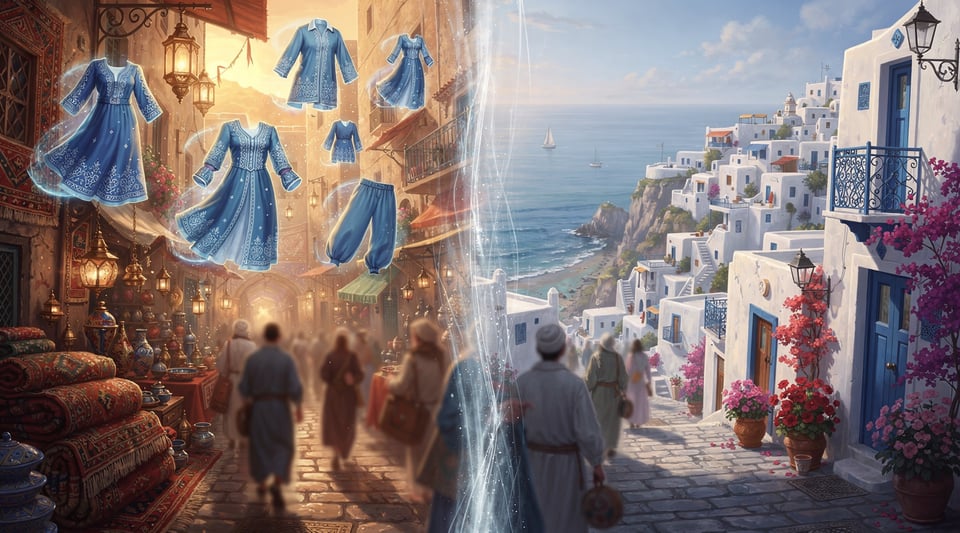
Origins of the village's blue and white palette
Sidi Bou Saïd is one of Tunisia's most photographed destinations: a cliffside village 20km northeast of Tunis where every wall is whitewashed and every door and window frame is painted a vivid cobalt blue. This wasn't a government invention — for generations, locals used white lime to cool their homes and blue paint to repel insects and resist the corrosive Mediterranean salt air. By the time of the French Protectorate, the village already looked this way organically. In 1915, residents themselves petitioned the colonial authorities to legally protect this aesthetic character. The resulting heritage decree, published in the Journal Officiel Tunisien on 28 August 1915, became one of Tunisia's earliest heritage preservation laws — predating Greece's own famous blue-and-white village standardisation by over two decades.
D'Erlanger myth and the village's legacy
French artist and musicologist Rodolphe d'Erlanger, who built his palace Ennejma Ezzahra in Sidi Bou Saïd, is sometimes credited (incorrectly) with inventing the colour scheme — he merely admired and promoted a tradition that already existed. The village has since drawn luminaries including Michel Foucault, André Gide, Aleister Crowley, and Paul Klee, and was added to Tunisia's UNESCO Tentative World Heritage List in 2024.
How the myth turned into a clothing ban
Somewhere along the chain of internet retelling, this legitimate architectural preservation decree — which mandates blue paint on buildings in one village — was distorted into a claim about a national ban on blue-coloured clothing imports. Tunisia has no such law. Its customs regulations (as documented by the U.S. International Trade Administration and Tunisian customs authorities) contain no colour-based clothing restrictions whatsoever. Tunisia is, in fact, described by multiple travel authorities as having no strict dress code for tourists.
Where the story gets it wrong
The myth claims Tunisia has a national ban on importing blue clothing. In reality, the real decree applies only to the village of Sidi Bou Saïd, governs building paint rather than clothing, protects blue paint rather than restricting it, and was initiated by residents themselves rather than imposed by authorities.
Some versions of the myth credit French expatriate Rodolphe d'Erlanger with inventing Sidi Bou Saïd's blue-and-white colour scheme. This is false — the aesthetic already existed before his arrival; he merely admired and promoted a tradition that predated him.
No such law exists. The actual related law is the Décret du 6 août 1915 relatif à la protection des constructions de Sidi Bou Saïd (Decree of 6 August 1915 on the Protection of the Buildings of Sidi Bou Saïd), published in the Journal Officiel Tunisien of 28 August 1915, p. 361. This decree formalised the protection of the village's existing blue-and-white architectural character. It governs building aesthetics in one specific village — it has no bearing on clothing, imports, or commerce anywhere in Tunisia.
- Current status
- Unknown
- Penalty
- N/A — law does not exist
- Jurisdiction
- The real underlying law (1915 decree) applies only to the village of Sidi Bou Saïd, approximately 20km northeast of Tunis. The claimed national law does not exist at any jurisdictional level.