“Austria Bans Brand Names as Baby Names — No, You Can't Call Your Kid 'Nutella'”
Austria genuinely prohibits parents from giving their children names that are brand names or product names, as part of a broader child welfare naming law. However, the framing that a 'government approval' process exists to bypass this ban is misleading — brand names are categorically rejected, not subject to a special approval pathway.
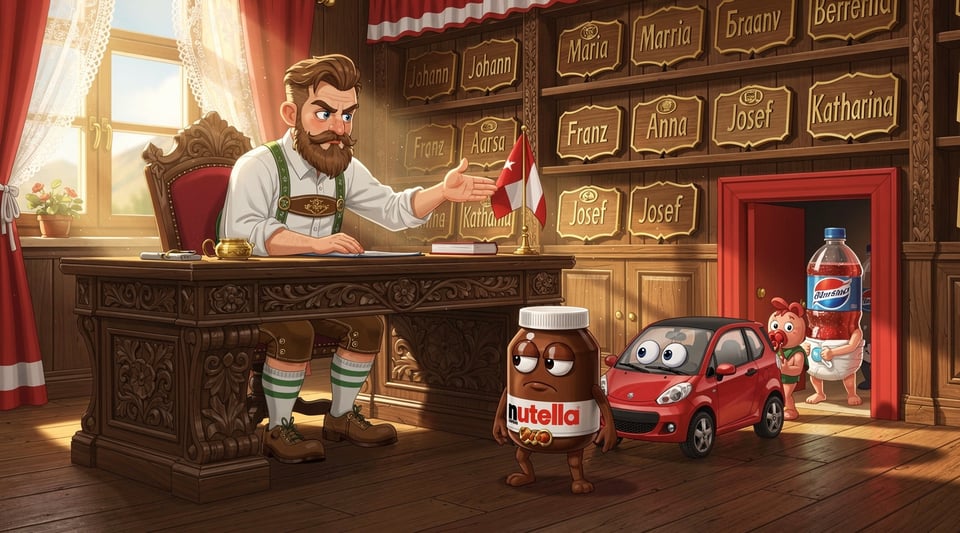
Civil status law and welfare principle
Austria's baby naming rules sit within a well-developed civil registration framework rooted in the Personenstandsgesetz (Civil Status Act) 2013. The guiding principle is straightforward: a name is a lifelong identifier and giving a child a ridiculous, offensive, or non-personal name is considered an act contrary to their welfare and best interests. The prohibition on brand names flows naturally from this logic — names like 'Nutella,' 'Sputnik,' or a car marque are objects or trademarks, not human identities, and forcing a child to carry one through life is seen as potentially embarrassing and harmful.
Comparative law and the approval myth
Austria is not alone in this; Germany, Iceland, Denmark, and Sweden all operate similar regimes. The 'government approval' angle in the claim appears to stem from the fact that parents must formally register their chosen name with the Standesamt before a birth certificate is issued — a process that does involve official review. However, this is better understood as a vetting/rejection mechanism than an approval-on-application system. There is no documented avenue to petition for special permission to use a brand name specifically; such names fall into a categorically rejected class.
Media coverage renewing the claim
A 2021 Kurier report highlighting a non-exhaustive list of banned Austrian baby names — including Nutella, Satan, and Sputnik — generated wide international coverage and likely refreshed the viral circulation of this claim.
Where the story gets it wrong
Some assume parents can seek 'government approval' to name a child after a brand, implying a special application process. In reality, brand and product names are simply refused by the registry office as categorically unsuitable as personal names — there is no documented pathway to override this refusal.
Some assume this restriction is uniquely Austrian or unusually strange. In fact, most European countries operate broadly similar child-welfare-based naming restrictions, so Austria's rule reflects a common regional standard rather than an outlier law.
Some believe the naming restriction applies to any child born in Austria. In fact, the rule technically only applies to children with Austrian citizenship/personal status (Personalstatut), not to children of foreign nationals born in the country.
Under Austria's Civil Status Act 2013 (Personenstandsgesetz 2013, PStG 2013) and related naming provisions, a child's first name must not be detrimental to the child's welfare, and must not be ridiculous or offensive. Names not typically associated with a person — including car brands, product names, cities, and comic book characters — are categorically prohibited. The name must also correspond to the child's gender. All first names must be submitted to the local registry office (Standesamt) before a birth certificate can be issued; if the office rejects a name, it alerts the guardianship court.
- Current status
- Actively Enforced
- Enacted
- January 1, 2013
- Penalty
- Prohibited name is refused registration; birth certificate cannot be issued until an acceptable name is provided. In cases of parental disagreement or non-compliance, the guardianship court (Pflegschaftsgericht) may be notified. No specific criminal fine for attempting to register a banned name.
- Jurisdiction
- National law applying across all of Austria. Applies specifically to children with Austrian 'personal status' (Personalstatut), typically Austrian citizens.