“In Austria, Honking Your Horn Is Almost Always Illegal”
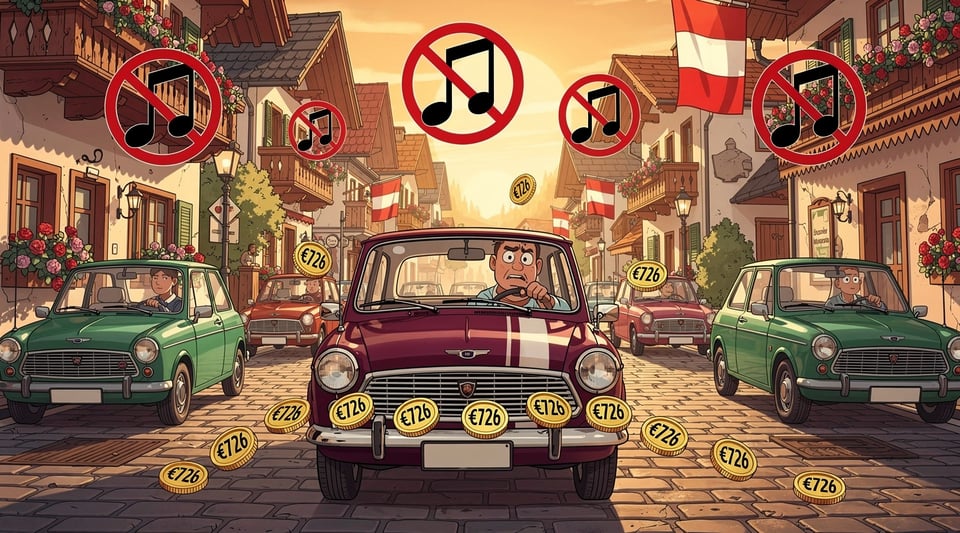
Austria's Straßenverkehrsordnung 1960 (StVO) prohibits sounding a car horn unless required by traffic safety, with designated 'Hupverbot' (horn prohibition) zones — like Vienna — imposing an even stricter standard. The law is real, but the commonly cited fine of €100 is wrong: the statutory maximum is €726.
Origins of the horn ban
Austria's horn ban traces back to the Straßenverkehrsordnung 1960, which came into force on 1 January 1961. Honking for frustration, to say goodbye, to celebrate a wedding convoy, or even to nudge a driver who missed a green light are all technically illegal nationwide.
Two layers of the law
The law has two layers. The first is the general national rule in §22: horns are banned unless traffic safety demands it. The second is a designated 'Hupverbot' zone system under §43, used in cities like Vienna (which posts horn-ban signs at every city entrance) where the threshold is even higher — honking is only permissible if it is the sole means to prevent injury to a person.
Motoring club confirms broad scope
The ÖAMTC (Austria's equivalent of the AA/AAA), the country's leading motoring club, has published multiple legal advisories confirming this, with its legal chief Martin Hoffer noting bluntly: 'In Austria there is fundamentally a horn ban — regardless of which vehicle you are using.' Bicycles, trams, and scooters are also covered: even ringing a bike bell without a safety justification is illegal.
Enforcement remains rare in practice
In practice, enforcement is rare. Austrian legal commentary and the ÖAMTC itself acknowledge that violations are 'selten bis kaum geahndet' (rarely to almost never penalised), particularly at weddings or sporting celebrations. Wedding convoys honking through town are technically illegal every time — but prosecutions remain essentially unheard of. The law is real; the threat of a fine is real; the chance of receiving one is very low.
Where the story gets it wrong
The commonly cited fine of 'up to €100' is inaccurate. The statutory maximum penalty under §99(3) StVO is €726, with up to two weeks' imprisonment if unpaid — the €100 figure circulates in travel articles but has no basis in the actual statute.
The ban is sometimes described as applying only in 'cases of immediate danger.' In fact, §22 prohibits sounding a horn in any situation where traffic safety does not require it — a broader, more nuanced test than immediate danger alone.
The rule is not uniform nationwide. In designated 'Hupverbot' zones such as Vienna, §43 imposes a stricter test: honking is permitted only when it is the sole means of preventing injury to a person, not merely when traffic safety generally demands it.
§22(2) of the Austrian StVO 1960 states: 'The giving of audible signals [Schallzeichen] is prohibited, unless required by the safety of traffic.' Additionally, §43(2) empowers authorities to designate specific areas — marked by official signage — as horn-prohibition zones, where horns may only be used 'if such a signal is the only means to avert danger from persons.' Violations are punishable under §99(3) as a Verwaltungsübertretung (administrative offence) with a fine of up to €726 or, if unpayable, up to two weeks' imprisonment.
- Current status
- Rarely Enforced
- Enacted
- January 1, 1961
- Penalty
- Administrative offence (Verwaltungsübertretung); fine up to €726 under §99(3) StVO, or up to 2 weeks' imprisonment if the fine is unpayable. Rarely enforced in practice.Fine: up to EUR726Imprisonment: 14 days
- Jurisdiction
- Applies nationwide under federal law (StVO 1960). Additional local 'Hupverbot' zones (e.g., all of Vienna) can impose stricter rules under §43(2) via municipal ordinance, marked with designated traffic signs.