“Bolivia Bans Non-Voters From Banks & Passports for 90 Days”
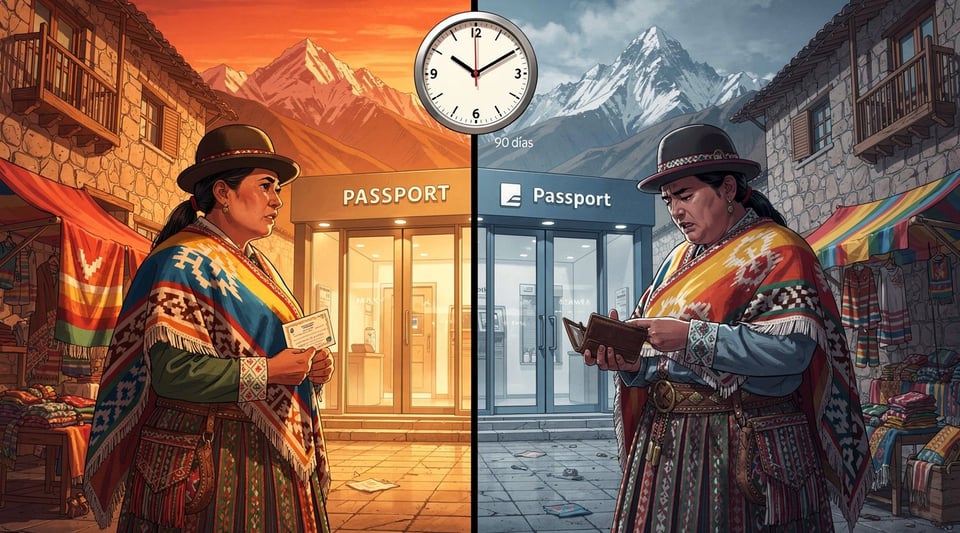
Bolivia legally requires all citizens aged 18–69 to vote in elections. Those who fail to vote and don't pay the fine lose access to banking services, public office positions, and passport applications for 90 days.
Constitutional and Legal Foundations
Bolivia's compulsory voting system is rooted in its 2009 Constitution (Article 26), which enshrines voting as both a right and an obligation for all citizens aged 18 and over. The current enforcement framework was codified in Ley N° 026 del Régimen Electoral, enacted on 30 June 2010 under President Evo Morales, which formalized the 90-day restriction on banking, public employment access, and passport issuance for non-voters.
How the Penalty System Works
Bolivia consistently achieves voter turnout of nearly 90%. The mechanism works as a two-stage system: first, a monetary fine is imposed; if the fine is unpaid, then civil restrictions kick in — blocking access to banks, government jobs, and passport services for three months. Citizens can avoid all penalties by obtaining a 'certificado de impedimento' (impediment certificate) if they can prove illness, being abroad, or other force majeure circumstances, backed by documentation. Citizens over 70 are fully exempt.
Enforcement and International Attention
The law is actively enforced. As recently as March 2026, following Bolivia's subnational elections, the Dirección General de Migración issued a formal directive requiring all passport applicants to present the voting certificate. Banks are legally mandated to demand the certificate for transactions. Government officials who fail to enforce the certificate requirement can themselves be fined up to 20% of the minimum salary. The system has attracted international attention from election monitoring bodies including the Carter Center and the European Parliament, both of which have documented and verified the penalties in official reports.
Where the story gets it wrong
Many assume the banking restriction functions as a separate fine. In reality, it is a civil consequence that only applies if the voter also fails to pay the required monetary fine — paying the fine clears all restrictions. The law also blocks passport access alongside banking, not just banking alone.
The 90-day restriction is sometimes assumed to be permanent, but it applies only for a fixed three-month period following the failure to vote and pay the fine, after which access is restored.
Citizens over 70 and those who are abroad on election day are fully exempt from penalties. Fines also vary by election cycle, set by the Electoral Tribunal; for recent general elections they reached up to 900 bolivianos (~USD 130).
Under Article 154 of Bolivia's Ley N° 026 del Régimen Electoral (2010), the Certificado de Sufragio (voting certificate) is the only document proving a citizen has fulfilled their voting obligation. Within 90 days following any election, citizens who cannot present either a voting certificate OR proof of having paid the non-voting fine are prohibited from: (1) accessing public office positions, (2) conducting bank transactions, and (3) obtaining a passport. Failure to vote is classified as an electoral offence under Article 233, with fines set by the Tribunal Supremo Electoral per election cycle — reaching up to 900 bolivianos (~USD 130) for general elections.
- Current status
- Actively Enforced
- Enacted
- June 30, 2010
- Penalty
- Monetary fine up to 900 bolivianos (~USD 130); if unpaid, 90-day ban on banking transactions, public office access, and passport applicationsFine: BOB137 – BOB900
- Jurisdiction
- National law applying to all Bolivian citizens aged 18–69 across the entire Plurinational State of Bolivia