“Photographing the Eiffel Tower at Night? It's Complicated — and Technically Illegal”
The Eiffel Tower's iconic nighttime light show is protected by French copyright law as an original artistic work, meaning commercial use of night photos requires prior authorization from the tower's operating company. However, simply taking the photo — or sharing it for personal use — is not illegal.
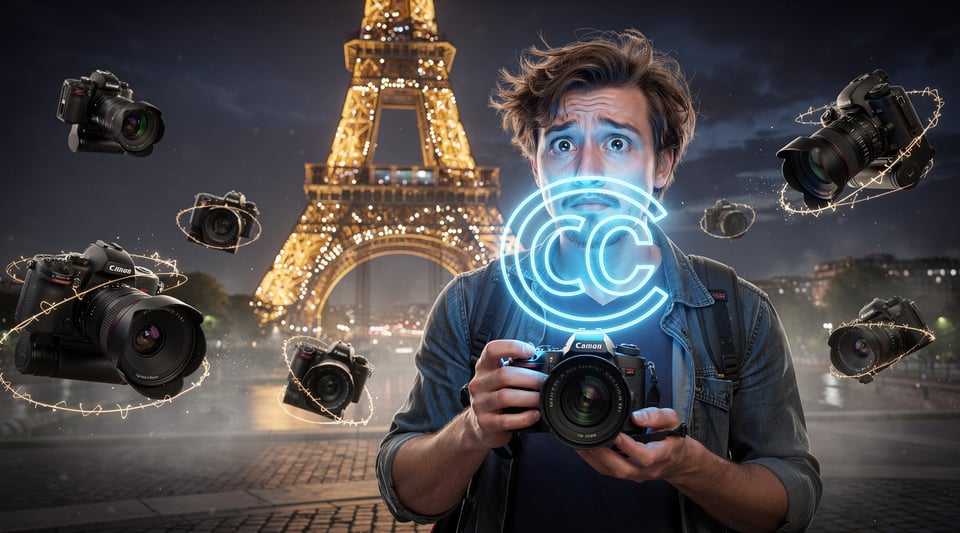
The Tower's History and Public Domain Status
The Eiffel Tower was completed in 1889 for the World's Fair. Gustave Eiffel died in 1923, and the tower itself entered the public domain in 1993 (70 years after his death). Daytime photos are entirely free. The controversy begins after dark.
The Light Show and Its Copyright Protection
In 1985, lighting designer Pierre Bideau installed the tower's famous golden illumination system, and in 2003 the sparkling 20,000-bulb twinkling display was added. French and EU copyright law treat original artistic works — including light installations — as protected creations. The Paris Court of Appeal confirmed as far back as 1990 (June 11, 1990 judgment) that the tower's illumination constitutes an original 'visual creation.'
France's Freedom of Panorama Exception
France, unlike the UK or Germany, historically opted out of the EU's 2001 Copyright Directive's optional 'freedom of panorama' provision, which would have allowed free photography of public structures. France partially reversed this in October 2016, introducing a limited panorama exception for non-commercial photos by individuals — but the law only explicitly covers 'architectural works and sculptures,' and legal scholars debate whether a light show qualifies.
Rights Holder and Enforcement Practices
SETE (Société d'Exploitation de la Tour Eiffel), the City of Paris-contracted operator, holds the copyright and actively licenses it commercially. Pierre Bideau died in 2021. Enforcement targets professional photographers, stock photo agencies, advertisers, and publishers. Nighttime Eiffel Tower photos are shared widely on social media with no legal consequences for ordinary visitors.
Where the story gets it wrong
The most common misconception is that it is outright 'illegal' to take or even possess a photograph of the Eiffel Tower at night — this is false. The restriction applies specifically to commercial distribution or publication of such images without SETE's permission. Personal photography and personal social media sharing are explicitly permitted by SETE.
A second misconception is that the 2016 French freedom of panorama law fully resolved the issue — it did not, as it only applies to non-commercial use by individuals, and there is ongoing debate about whether a light installation qualifies as an 'architectural work or sculpture' under the exception.
A third misconception conflates the structure, which has been in the public domain since 1993, with the separately protected light show, which remains under copyright.
- Current status
- Rarely Enforced
- Enacted
- January 1, 1985
- Penalty
- Copyright infringement under Article L335-2 CPI: up to 3 years imprisonment and up to €300,000 fine. In practice, commercial violators face licensing demands, cease-and-desist orders, and civil damages. No tourist has been prosecuted.Fine: up to EUR300,000
- Jurisdiction
- National French law (Code de la Propriété Intellectuelle); the monument is located in Paris, 7th arrondissement. Copyright is governed at the national level in France.