“In France, You Can Legally Marry a Dead Person — With the President's Blessing”
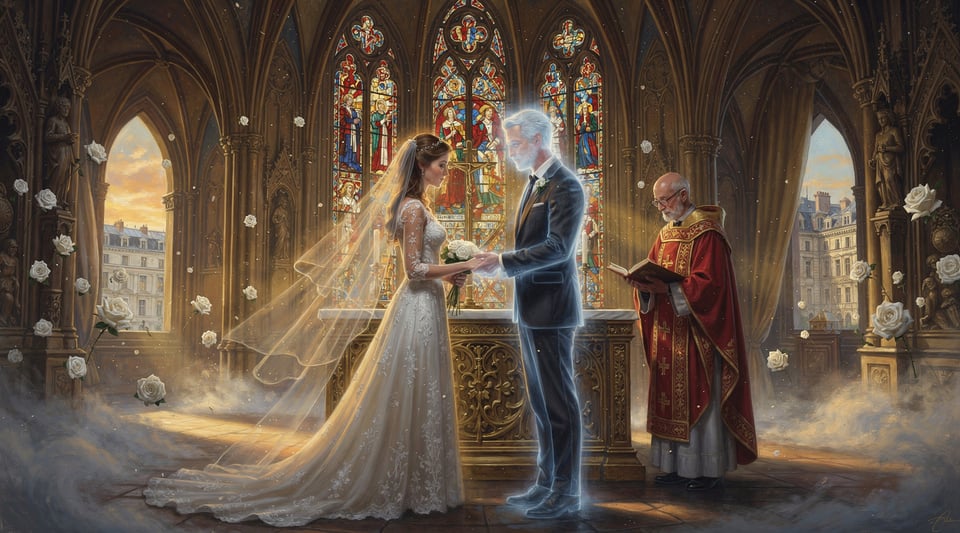
France legally permits 'posthumous marriage' (mariage posthume) under Article 171 of the French Civil Code. A surviving partner can marry their deceased fiancé(e), but only with presidential approval and under strict conditions proving the deceased had clearly consented to the union before death.
Napoleonic origins and wartime revival
France's posthumous marriage law has roots stretching back to Napoleon's Code Civil of 1803, when proxy-style unions were permitted to protect widows of fallen soldiers and legitimise their children. The practice was revived and formalised during the First and Second World Wars for similar reasons.
The Malpasset Dam disaster
The modern civilian version of the law, however, was born out of tragedy: on December 2, 1959, the Malpasset Dam near Fréjus catastrophically collapsed, killing over 400 people — including men who were engaged to be married. One pregnant fiancée, Irène Jodart, petitioned President Charles de Gaulle to allow her to proceed with her marriage plans. Public sympathy was overwhelming, and within months, the French parliament inserted Article 23 into the dam-disaster compensation bill, which became Article 171 of the Civil Code.
Legitimising children and modern applications
The law was originally designed to legitimise children born out of wedlock, as French law at the time treated 'legitimate' and 'natural' children unequally in inheritance. Today, between 60 and 100 applications are submitted annually, with roughly half approved. Notable recent cases include the 2017 posthumous marriage of Étienne Cardiles to police officer Xavier Jugelé (killed in a terrorist attack on the Champs-Élysées), and a 2023 case where a 64-year-old retiree married her partner of 40 years who had died in 2020.
How the ceremony is conducted
The ceremony is officiated by a local mayor, who reads the presidential decree; a photograph of the deceased typically stands in their place. The surviving spouse immediately becomes a widow or widower upon the marriage being declared.
Where the story gets it wrong
It is not a free right: many assume anyone can request a posthumous marriage, but the President of the Republic must personally authorise each case via decree, and roughly half of all requests are rejected.
It is not open to just anyone: strict legal conditions require documented, unequivocal proof that the deceased intended to marry, such as published banns or wedding reservations. Pregnancy alone or a promise letter is insufficient.
The marriage does not grant full spousal rights: the surviving partner receives no inheritance or matrimonial property rights from the deceased's estate. Benefits are limited to symbolic recognition, use of the deceased's surname, possible pension benefits, and legitimation of children.
Article 171 of the French Civil Code states (paraphrased): 'The President of the Republic may, for serious reasons, authorize the solemnization of a marriage when one of the intended spouses has died, provided that a sufficient body of facts unequivocally establishes that person's consent. In such cases, the effects of the marriage are backdated to the day preceding the death of the deceased spouse. However, this marriage does not entail any right of intestate succession for the benefit of the surviving spouse, and no matrimonial property regime is deemed to have existed between the spouses.'
- Current status
- Actively Enforced
- Enacted
- December 31, 1959
- Penalty
- Not applicable — this is a permissive law granting a right, not a criminal statute with penalties.
- Jurisdiction
- Applies across all of France under the national Civil Code. Military posthumous marriages involving those killed in military operations have a parallel provision under Article 96-1 of the Civil Code, requiring authorisation from the Minister of the Armed Forces and the Minister of Justice.