“Indonesia's Civil Servants Do Morning Exercise — But Is It Actually the Law?”
Morning exercise sessions (senam pagi) are a widespread, culturally embedded practice at Indonesian government offices, and many agencies require attendance. However, there is no national statute specifically mandating civil servant exercise with formal disciplinary penalties under Indonesia's civil service discipline framework.
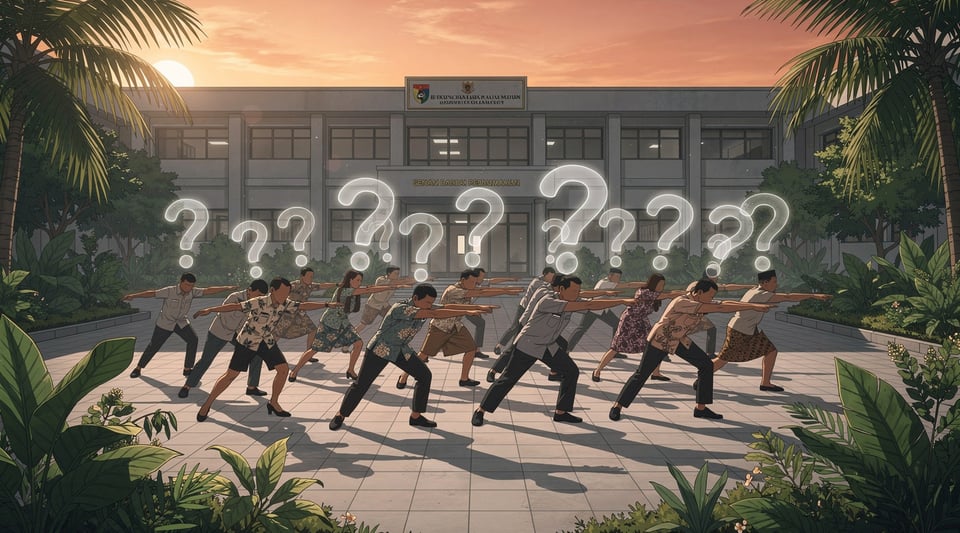
Senam Pagi Becomes Office Tradition
Morning exercise — known as 'senam pagi' — has been part of Indonesian government office culture for decades, rooted in the country's broader national fitness traditions. The Indonesian government has long promoted physical fitness as a public health and bureaucratic productivity goal, and weekly or daily group exercise sessions became a fixture at ministries, regional offices, and state agencies. Videos and news releases from government offices across the archipelago — from the national statistics agency (BPS) to local civil service boards — regularly document these sessions.
The Legal Basis Cited
The legal basis most commonly cited is PP No. 94 of 2021 on Civil Servant Discipline, which replaced the earlier PP No. 53 of 2010. This regulation sets 17 obligations for civil servants enforceable with tiered disciplinary sanctions ranging from verbal reprimands to dismissal. One obligation — compliance with official regulations set by authorized officials — gives individual agencies the legal hook to require attendance at institutional activities like exercise sessions.
Why The Claim Overstates Reality
However, the claim that there is a specific national law requiring exercise during work hours with disciplinary consequences overstates the case. Exercise is not enumerated as one of the 17 specific obligations in PP 94/2021, and no dedicated national legislation mandates it. The practice is culturally normative, institutionally encouraged, and sometimes enforced at the agency level — making this a case of a real tradition that gets exaggerated into a 'weird law' when shared internationally.
Where the story gets it wrong
The claim is often stated as though a specific national law requires civil servants to exercise, with direct disciplinary consequences for non-compliance. In reality, PP 94/2021 does not list exercise among its 17 obligations. What exists is a cultural tradition of senam pagi, enforced only indirectly through general disciplinary provisions — not a dedicated national statute.
Government Regulation No. 94 of 2021 (PP 94/2021) on Civil Servant Discipline sets out 17 mandatory obligations and 14 prohibitions for Indonesian civil servants (PNS). These obligations cover loyalty to the state, policy compliance, working-hours attendance, integrity, and professional conduct — but physical exercise or participation in senam (gymnastics/exercise sessions) is not listed among them. Individual government agencies widely implement morning exercise (senam pagi) as an institutional routine, and general disciplinary rules allow agencies to require participation in official activities as part of 'compliance with official regulations set by authorized officials' (Pasal 3 huruf n PP 94/2021). Violation of agency-level directives can trigger light disciplinary sanctions under the same regulation.
- Current status
- Rarely Enforced
- Enacted
- August 31, 2021
- Penalty
- Under PP 94/2021, violations of official institutional directives can attract light disciplinary sanctions: verbal reprimand, written reprimand, or statement of dissatisfaction from a superior. Medium sanctions include deferral of salary increment (1 year), deferral of promotion (1 year), or demotion for 1 year. Severe sanctions range from demotion to dismissal. In practice, skipping exercise sessions — where mandated at agency level — would typically result only in a verbal or written reprimand at most.
- Jurisdiction
- The civil service discipline framework (PP 94/2021) is national in scope, applying to all Pegawai Negeri Sipil (PNS) across Indonesia. Exercise requirements, where enforced, are implemented at the agency/institutional level under general disciplinary authority.