“Bare Bums Banned in the Alps — But Only in One Swiss Canton”
Naked hiking is NOT illegal across Switzerland under federal law. But the canton of Appenzell Innerrhoden banned it at its 2009 Landsgemeinde, and its fixed-penalty schedule still sets a CHF 200 fine for "being naked in public" — though cantonal police say nobody has been reported in years.
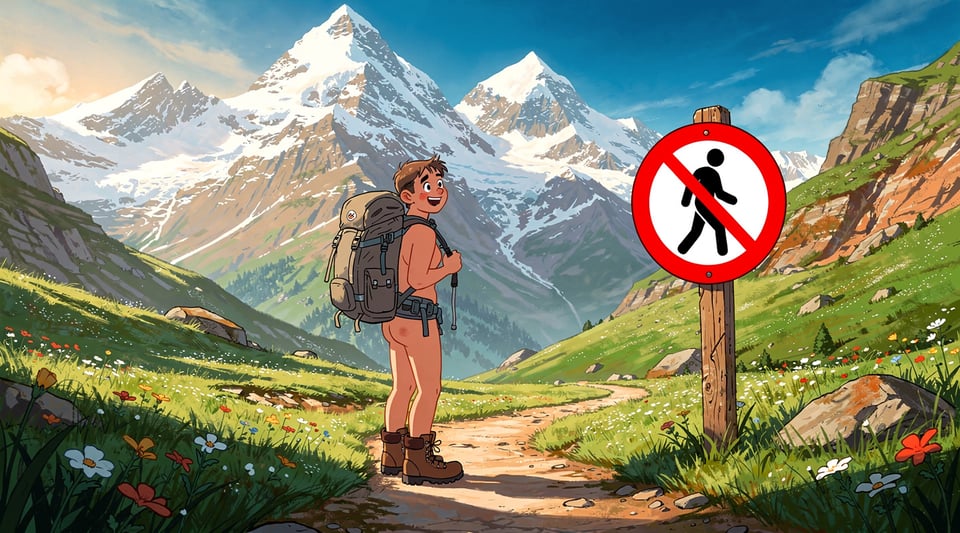
Nude hikers discover the Appenzell Alps
The story began around 2008–2009 when nudists — many of them German, inspired by the Freikörperkultur ('Free Body Culture') movement — discovered the scenic Alpine trails of the Appenzell region and began hiking in the nude. The Alpstein became something of an unintentional nude hiking destination, promoted on German-language websites as a free and healthy way to experience nature.
A conservative canton votes to ban
Appenzell Innerrhoden is one of Switzerland's most conservative cantons — it was the last to grant women the vote, in 1990. Locals were unimpressed: public broadcaster SRF recorded the prevailing view that nude hikers were 'Grüsel' and 'Spinnsiechen'. On 26 April 2009 the open-air Landsgemeinde assembly voted by a show of hands to widen Art. 15 of the cantonal Übertretungsstrafgesetz to cover publicly offensive conduct, and that June the Grosse Rat added 'being naked in public' to the fixed-penalty schedule at CHF 200.
The court case was in the other Appenzell
The test case that reached Switzerland's highest court was not an Innerrhoden case at all. A man who hiked naked past a family barbecue spot and a Christian drug rehabilitation centre near Herisau, in neighbouring Appenzell Ausserrhoden, was fined CHF 100 under that canton's general public-decency clause — a different law, a different canton, and a different amount from Innerrhoden's CHF 200 fixed penalty. In BGE 138 IV 13 of 17 November 2011 the Federal Court dismissed his appeal, holding that cantons may criminalise naked hiking under Art. 335 of the Swiss Criminal Code. The ruling confirmed the cantons' power to legislate here; it did not review Innerrhoden's ordinance.
A ban almost nobody has been fined under
Ten years on, SRF found the penalty had gone essentially unused. 'We have certainly not received any reports for eight or nine years,' cantonal police officer Roland Koster told the broadcaster in April 2019. Whether that reflects the ban's deterrent effect or simply the fading of a brief craze, he said, could not be determined. The CHF 200 entry remains in the schedule, and across the rest of Switzerland — which has officially designated nude beaches — naked hiking remains lawful.
Where the story gets it wrong
That Switzerland as a whole bans naked hiking. Federal law does not criminalise public nudity or naked hiking. The named prohibition exists in the canton of Appenzell Innerrhoden; elsewhere, including other Alpine cantons, naked hiking is lawful, and Switzerland has officially designated nude beaches.
That the CHF 200 fine and the CHF 100 fine are a contradiction, or that Switzerland's Federal Court upheld Appenzell Innerrhoden's ban. They are two different cantons. CHF 200 is Innerrhoden's fixed on-the-spot penalty. CHF 100 was the fine imposed in the 2011 Federal Court case, which arose in Appenzell Ausserrhoden under that canton's general decency clause. The court confirmed that cantons may punish naked hiking; it never ruled on the Innerrhoden ordinance.
Art. 15 of the Übertretungsstrafgesetz of the canton of Appenzell Innerrhoden of 30 April 2006 (UeStG, GS 311.000), headed "Lärm, grober Unfug und anstössiges Verhalten", as supplemented by the Landsgemeinde decision of 26 April 2009: "Wer mutwillig durch Lärm oder groben Unfug, insbesondere zur Nachtzeit, jemanden stört oder belästigt, oder wer sich öffentlich ein anstössiges, Sitte oder Anstand verletzendes Verhalten zuschulden kommen lässt, wird mit Busse bestraft." ("Whoever wilfully disturbs or annoys another by noise or gross mischief, particularly at night, or who publicly engages in offensive conduct violating morals or decency, shall be punished with a fine.") The article does not name nudity. The naked-hiking penalty is set in the fixed-penalty schedule made under Art. 4 Abs. 2 UeStG — Anhang 1 of the Verordnung über die Ordnungsbussen (VOB, GS 311.010), item 1.10: "Nacktes Aufhalten in der Öffentlichkeit (Art. 15 UeStG) — 200.--" ("Being naked in public — CHF 200"). That entry has carried the same CHF 200 figure since the ordinance of 15 June 2009 and remains in the schedule as it stands on 31 March 2025. Swiss federal law contains no equivalent prohibition on public nudity or naked hiking.
- Current status
- Rarely Enforced
- Enacted
- April 26, 2009
- Penalty
- Fixed penalty (Ordnungsbusse) of CHF 200 for "nacktes Aufhalten in der Öffentlichkeit" under Anhang 1 Ziff. 1.10 of the cantonal Verordnung über die Ordnungsbussen. Police may collect it on the spot only if the offender consents (Art. 4 Abs. 2 UeStG); otherwise the case proceeds as an ordinary prosecution under Art. 15 UeStG.Fine: CHF200 – CHF200
- Jurisdiction
- Applies to the canton of Appenzell Innerrhoden, the only Swiss canton whose fixed-penalty schedule names public nudity by title (Anhang 1 Ziff. 1.10 VOB). Swiss federal law does not prohibit naked hiking. Neighbouring Appenzell Ausserrhoden has no nudity-specific provision, but convicted a nude hiker under its general public-decency clause (Art. 19 Abs. 2 Strafrecht/AR); the Federal Court upheld that conviction in BGE 138 IV 13 (2011). The two cantons are distinct jurisdictions and their penalties differ.