“Seoul Bans Food on Buses — But Subway Eating Is Perfectly Legal”
Seoul has a real ordinance restricting certain food and drinks on city buses since 2018, but there is no law whatsoever banning eating on Seoul's subways. The claimed ₩100,000 fine does not exist for this offense.
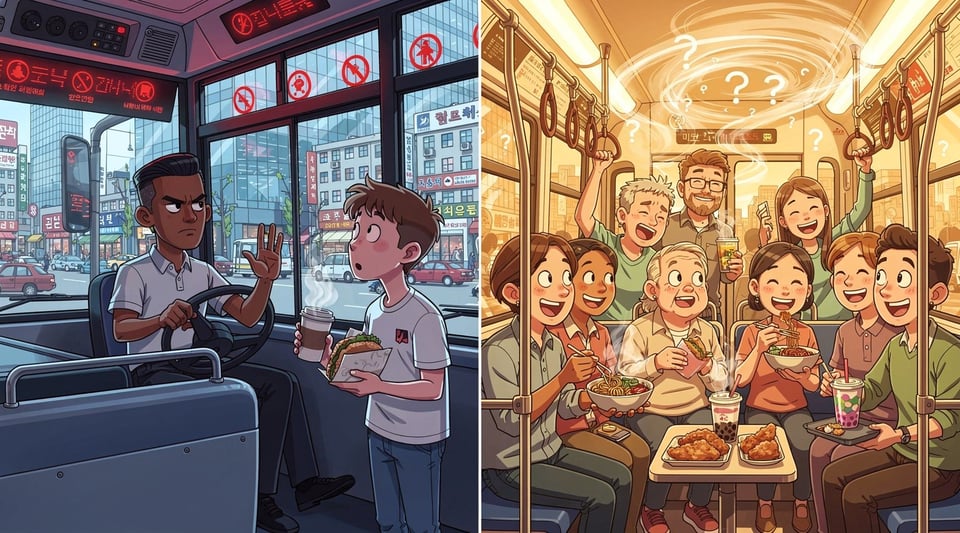
The bus restriction is real but limited
Seoul's public transportation eating rules exist in one form and are widely misunderstood in another. The bus restriction is real and was enacted on January 4, 2018, after years of complaints from riders about spilled takeout coffee, strong food smells, and littering. The ordinance gives bus drivers the right to refuse boarding to passengers carrying spill-risk items like open takeout cups or unwrapped food ready to eat. Boxed fried chicken and sealed plastic bottles are allowed, since the rule targets spillage risk and on-board consumption rather than food in general. There is no passenger fine; the only enforcement mechanism is the driver's right to deny boarding or request a passenger leave.
No law exists for subway eating
The subway is an entirely different story. Despite generating nearly 1,000 complaints per year — including viral incidents of passengers eating cup noodles, sashimi, and fried chicken on crowded carriages — there is legally nothing Seoul Metro can do. The agency itself acknowledged in 2025 that enforcement is impossible: Seoul's subway is operated by 11 separate rail agencies, making a unified ordinance extremely difficult to draft, and unlike buses, subway operators cannot monitor passengers at the point of entry. Seoul City Councilor Yoon Young-hee publicly called for a subway eating ban in November 2025, and Seoul Metro's president said it would be 'actively reviewed,' meaning as of 2026, no law yet exists.
Where the fine figure actually comes from
The ₩100,000 fine in the claim appears to be a conflation with South Korea's well-known ₩100,000 fine for smoking in no-smoking zones — a completely separate regulation. Comparable fines for subway eating do exist in Singapore (up to S$500) and Hong Kong (up to HK$2,000).
Where the story gets it wrong
The claim incorrectly states the ban covers both subways and buses, but only Seoul's buses have a legal restriction on food and drink; there is no law restricting eating on Seoul's subway trains despite public complaints.
There is no ₩100,000 fine for eating on public transit; the ₩100,000 figure actually applies to smoking violations, a completely separate regulation from any transit food rule.
The bus rule is not a blanket eating ban — it only restricts spill-prone open food and drinks intended for on-board consumption; sealed containers and packaged groceries like boxed fried chicken remain allowed, and there is no criminal or monetary penalty for passengers, since a driver's only enforcement power is to refuse boarding or ask someone to leave.
Under the Seoul Metropolitan City Ordinance on City Bus Financial Support and Safe Operation Standards (서울특별시 시내버스 재정지원 및 안전 운행기준에 관한 조례), Article 11, Clause 6, bus drivers may refuse boarding to passengers carrying food or beverages in disposable takeout cups, open/unpackaged food intended for consumption on board, or beverages without lids. Drivers may also request such passengers to disembark. No equivalent law exists for the Seoul subway system, where eating is not prohibited. Seoul Metro's passenger transport regulations (여객운송약관) contain only a soft clause restricting items that are 'unsanitary or may cause discomfort due to odor,' which does not specifically cover food consumption and carries no enforceable fine.
- Current status
- Actively Enforced
- Enacted
- January 4, 2018
- Penalty
- No monetary fine. Bus drivers may refuse boarding or request the passenger to disembark. No penalty applies on the subway, where eating is not prohibited.
- Jurisdiction
- Bus ordinance applies to Seoul city-operated buses (including branch, trunk, wide-area, and circular bus lines operating within Seoul). No equivalent rule exists for Seoul Metro subway lines (lines 1–9 and affiliated operators). Other cities such as Daegu have similar but separate bus ordinances.