“In Sri Lanka, Defacing or Mutilating Rupee Notes Can Land You in Jail”
Sri Lanka has a genuine law prohibiting the mutilation, defacement, or alteration of currency notes and coins, carrying penalties of up to Rs. 25 million and 3 years' imprisonment. However, the claim that it is 'similar to Thailand's currency law' is misleading — the two laws exist for entirely different reasons.
What the statute actually says, and where the penalty lives
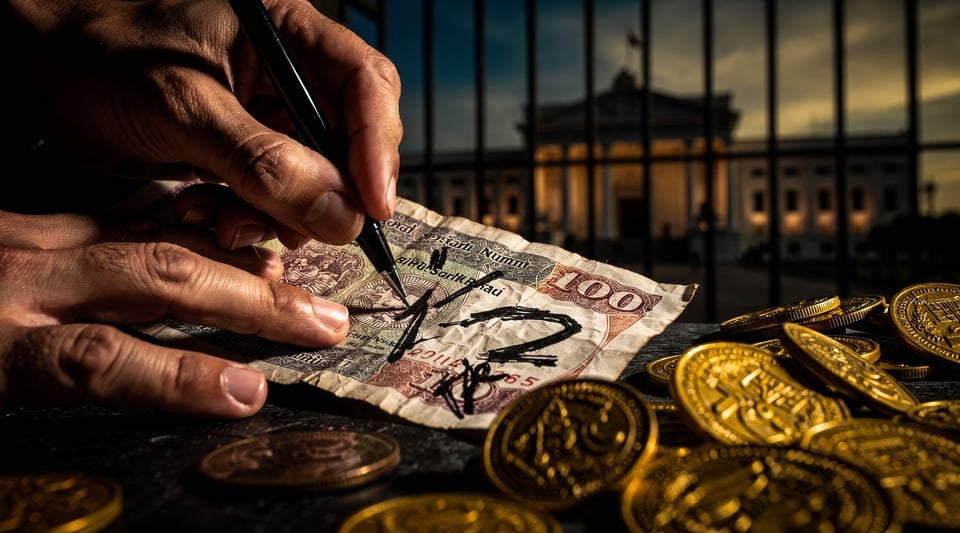
Sri Lanka has protected its currency from physical damage since at least the Monetary Law Act No. 58 of 1949, with the prohibition carried forward and strengthened in the Central Bank of Sri Lanka Act No. 16 of 2023, certified on 14 September 2023. Section 55 makes it an offence, without the authority of the Governing Board, to cut, perforate or otherwise mutilate a currency note, to print, stamp or draw upon one, to affix an advertisement to one, or to reproduce or make a facsimile of one; section 56 does the equivalent for melting, breaking up or mutilating coins. Neither section sets its own punishment. Section 110(1) makes any contravention of the Act an offence, and section 111 supplies the ceiling: on conviction after summary trial before a Magistrate, a fine not exceeding twenty-five million rupees, imprisonment of either description for up to three years, or both. News coverage of the CBSL's 2024 notice generally attributes the Rs. 25 million figure to section 55 itself, but the figure appears nowhere in section 55 — it comes from section 111. The prohibition is rooted in economics and monetary integrity: each note is expensive to produce (100% cotton pulp with sophisticated security features, printed at De La Rue Lanka Currency & Security Print), and wilful destruction forces the CBSL to spend public funds reprinting notes unnecessarily.
A 2024 notice targeting a viral trend
In March 2024, the CBSL's Superintendent of Currency issued a special public notice to members of the public advising against the wilful mutilation or defacement of currency notes, prompted by a trend of using notes to prepare ornaments and gift items and promoting such activities on social media — a sign that the provision is not merely dormant.
Comparison with Thailand's lèse-majesté law
The claim that Sri Lanka's law is 'similar to Thailand's currency law' is a widespread misconception. Thailand's prohibition on stepping on currency is rooted in its lèse-majesté law (Section 112 of the Thai Criminal Code), which punishes whoever defames, insults or threatens the King, the Queen, the Heir-apparent or the Regent with imprisonment of three to fifteen years. Thai coins and notes bear the image of the king, and using one's feet — considered the dirtiest part of the body in Thai culture — on the monarch's image is treated as royal insult. Sri Lanka's law has no royal dimension whatsoever; it is a straightforward monetary and financial integrity statute, and its penalty is a fine or up to three years, not a term for insulting a head of state.
Stepping on currency and accidental damage
The specific act of 'stepping on' currency is also not named anywhere in Sri Lankan law — it would only be an offence if it amounted to wilful mutilation or defacement under section 55. Accidental damage from everyday handling is treated separately and may be exchanged at commercial banks; only wilfully mutilated or altered notes are forfeited under Regulation "E", with no claim entertained for their face value.
Where the story gets it wrong
The law is often compared to Thailand's currency law, but the two are fundamentally different: Thailand's prohibition is driven by lèse-majesté (protecting the king's image on coins and notes), while Sri Lanka's is purely an economic and monetary integrity law with no royal dimension.
The claim focuses on 'stepping on' currency, which is not explicitly enumerated in Sri Lanka's law — the offence is wilful mutilation or defacement, of which stepping could only theoretically be a subset if it damages the note.
Some assume any damage to currency is punishable, but only wilful mutilation or defacement is an offence under the law; accidental damage from everyday handling is treated separately and may be exchanged at commercial banks.
55. Any person who without the authority of the Governing Board— (a) cuts, perforates, or in any other way whatsoever mutilates any currency note; (b) prints, stamps, or draws anything upon any currency note, or affixes any seal or stamp to or upon any currency note; (c) attaches or affixes to or upon any currency note anything in the nature or form of an advertisement; (d) reproduces in any form whatsoever, or makes a facsimile of, any currency note; or (e) uses otherwise as a legal tender, any currency note, commits an offence. 56. (1) Any person who, without the authority of the Governing Board, melts, breaks up, perforates, mutilates or uses otherwise than as legal tender, any coin which is legal tender in Sri Lanka commits an offence. (2) Any person who knowingly uses, possesses or deals with any metal or article which he knows or has reasonable cause to believe, is derived from any coin which has been dealt with in contravention of subsection (1), commits an offence. 110. (1) Any person who contravenes or fails to comply with any provision of this Act commits an offence under this Act. 111. Any person who commits an offence under this Act shall, on conviction after summary trial before a Magistrate, be liable to a fine not exceeding twenty-five million rupees or to imprisonment of either description for a term not exceeding three years, or to both such fine and imprisonment.
- Current status
- Actively Enforced
- Enacted
- September 14, 2023
- Penalty
- Under s. 111 of the Central Bank of Sri Lanka Act, No. 16 of 2023, a person who commits an offence under the Act is liable, on conviction after summary trial before a Magistrate, to a fine not exceeding Rs. 25,000,000 (Sri Lankan Rupees), imprisonment of either description for up to 3 years, or both. Sections 55 and 56 create the offence but prescribe no penalty of their own. Wilfully mutilated or altered notes are additionally forfeited: under Regulation "E" the CBSL entertains no claim in respect of them, and the holder loses their face value.
- Jurisdiction
- National law applicable throughout Sri Lanka, enforced by the Central Bank of Sri Lanka and the Sri Lanka Police.