“Tunisia Really Does Fine Businesses for Price Display — But French Isn't Required”
Tunisian businesses are legally required to display prices and must include Arabic on commercial signage and product labels — with fines of up to 2,000 dinars for non-compliance. However, the claim that French must also be displayed alongside Arabic is a mischaracterization: the law mandates Arabic, not a French-Arabic bilingual requirement.
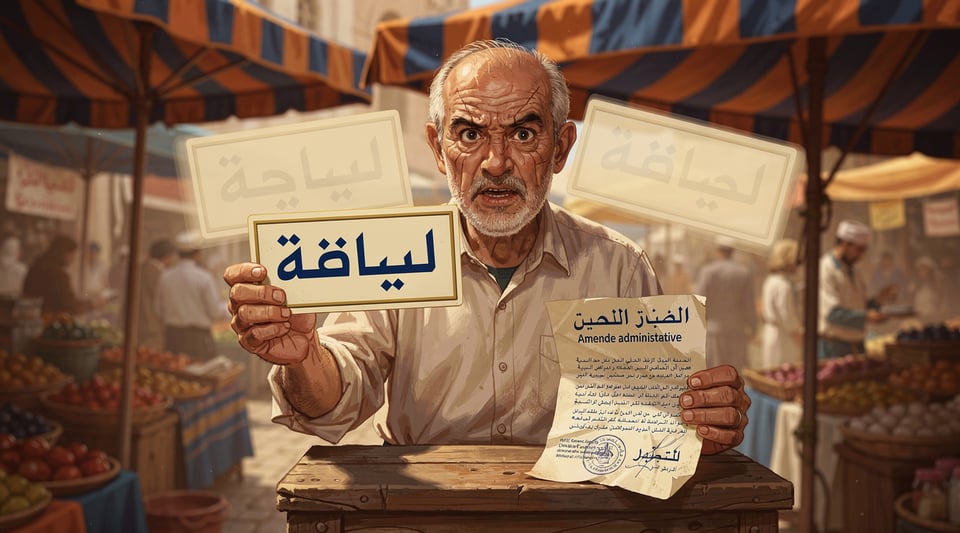
Tunisia's linguistic landscape is a product of its layered colonial history. Arabic is the sole official language under the Tunisian Constitution, but French — introduced during the French Protectorate (1881–1956) — remained deeply embedded in commerce, higher education, and administration long after independence. Today, roughly 63% of Tunisians speak French to varying degrees, and French is effectively the language of business in urban Tunisia, while Arabic dominates courts, government, and formal education.
This dual reality created a regulatory patchwork. Tunisia's price display obligations under Law No. 2015-36 (2015) are genuine and actively enforced: authorities reminded businesses as recently as May 2026 that failure to display prices is a punishable offense carrying fines of 50–2,000 dinars. The Arabic language requirement for signage also has real legal teeth — since 1999, private establishments have been obliged to give Arabic characters prominence on their signs. A Tunis city council measure in December 2018 reignited a national debate by requiring businesses to integrate Arabic on their signage, which was seen by some as a sovereignty measure and by others as authoritarian overreach.
Where the claim goes wrong is in asserting a symmetric bilingual French-Arabic mandate. The law requires Arabic — it does not require French. In practice, French dominates many commercial displays precisely because it is culturally expected, but that is business custom, not statute. The U.S. Commercial Service notes that legally, the dominant portion of any storefront sign must appear in Arabic — and that in practice this is 'irregularly enforced.' The result is a law that is simultaneously real, genuinely strange (requiring a minority official language to be featured prominently in a country where French actually dominates commerce), and frequently misunderstood.
Where the story gets it wrong
The most common misconception is that Tunisian law mandates a French-Arabic bilingual format for price displays — it does not. Arabic is the legally mandated language; French is not required by law for price tags or general commercial price displays. The technical product instruction rules do reference 'Arabic and French or English,' but this applies to product warranties/instruction manuals under the consumer protection framework, not to price display per se. Additionally, while the price display law with fines is real and current, enforcement of the Arabic signage/dominant-language rule is inconsistent in practice, with French and even English signs common in urban storefronts.
Law No. 2015-36 of September 15, 2015 on the Reorganization of Competition and Prices (Article 46) requires businesses to display prices and imposes financial penalties of 50 to 2,000 Tunisian dinars for failure to display prices, incomplete price display, or non-compliant price schedules. Separately, the 1992 Consumer Protection Law (Law No. 92-117) and associated Decree #2003-1718 require that Arabic be one of the languages used on product labels and commercial signage. Storefront signs must give dominance to Arabic text. Technical product instructions must be provided in 'Arabic and French or English.' French is not independently mandated for price tags or general price displays.
- Current status
- Actively Enforced
- Enacted
- September 15, 2015
- Penalty
- Fine of 50 to 2,000 Tunisian dinars for failure to display prices, incomplete price display, or non-compliant price schedules (Article 46, Law No. 2015-36)Fine: TND50 – TND2,000
- Jurisdiction
- National law, applies across Tunisia. The Tunis city council also passed a complementary municipal measure in December 2018 specifically targeting business signage.