“Arkansas Made Its Own Name's Pronunciation Officially Illegal to Mispronounce”
Arkansas has a real, still-active law codifying the official pronunciation of its name as 'AR-kan-saw,' passed in 1881. However, the law carries absolutely no penalty and has never been enforced — making the popular claim that mispronunciation is 'illegal' a significant overstatement.
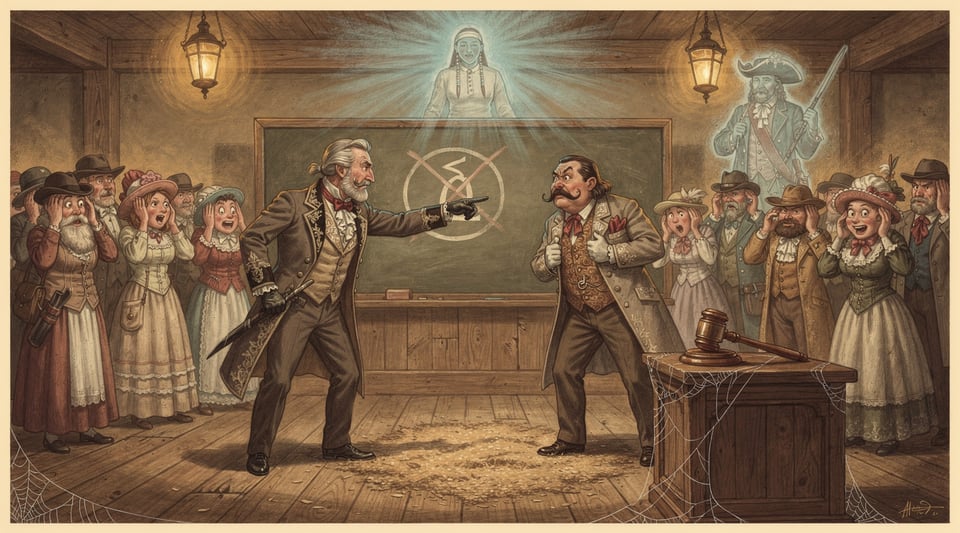
A Feud Over Two Pronunciations
In the late 19th century, Arkansas was a state divided — not by politics in the usual sense, but by something far more personal: how to say its own name. Two state senators led opposing camps. Senator Cassius M. Johnson championed the anglicized 'Ar-KAN-zas,' treating the state like a phonetic cousin of neighboring Kansas. Senator James K. Jones insisted on 'AR-kan-saw,' honoring the French rendering of the original Native American word. The feud grew heated enough to stall legislative business.
A Study Settles the Question
In 1881, the General Assembly commissioned a formal study via the Historical Society of Arkansas and the Eclectic Society of Little Rock, whose findings supported the French-influenced pronunciation. A concurrent resolution was passed, cementing 'AR-kan-saw' into the official record and making Arkansas the only U.S. state with a law specifically dictating the phonetic pronunciation of its own name. The resolution was folded into the Arkansas Code under Title 1, General Provisions, where it sits today — dusty but technically alive.
No Penalty Was Ever Attached
The catch? It was always a declaratory resolution, not a criminal statute. There is no fine, no jail time, no enforcement mechanism, and no penalty clause of any kind. No Arkansan has ever been charged, cited, or so much as given a parking ticket for saying 'Ar-KAN-zas.' The 'illegal' framing is a beloved piece of legislative mythology, but the real story — a political feud settled by a linguistics committee in 1881 — is arguably even better.
Where the story gets it wrong
Many assume mispronouncing 'Arkansas' is a criminal offense carrying a fine. In reality, the 1881 resolution is a declaratory/concurrent resolution expressing the legislature's preference, with no criminal penalty, civil infraction, or enforcement mechanism — no such fine exists in Arkansas Code Annotated or any criminal statute.
The law is also often described as forbidding mispronunciation, but it uses language urging the pronunciation 'to be discouraged,' not 'prohibited.' Enforcing it as an actual ban would likely violate the First Amendment's protections against compelled speech.
Arkansas Code § 1-4-105 (originally Concurrent Resolution No. 4 of 1881) resolves that 'the only true pronunciation of the name of the state... is that received by the French from the native Indians.' It shall be pronounced in three syllables, with the final 's' silent, the 'a' in each syllable with the Italian sound, and the accent on the first and last syllables. The pronunciation with the accent on the second syllable and the sounding of the terminal 's' is 'an innovation to be discouraged.' No penalty clause exists anywhere in the statute.
- Current status
- Never Enforced
- Enacted
- January 1, 1881
- Penalty
- No penalty exists. The resolution contains no fine, no criminal classification, and no enforcement mechanism of any kind. Social correction by Arkansans is the only real consequence.
- Jurisdiction
- State of Arkansas. Codified in Arkansas Code Title 1 (General Provisions), Chapter 4 (State Symbols). Applies statewide.