“Yes, Burning Money IS Illegal in the U.S. — But There's a Catch”
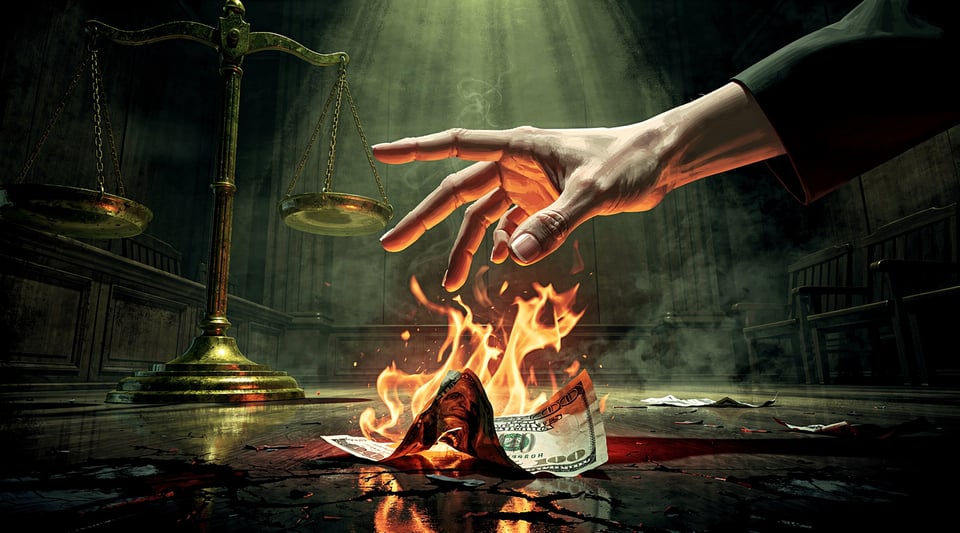
It is a federal crime to intentionally destroy U.S. currency under 18 U.S.C. § 333, which prohibits mutilating or defacing banknotes with the intent to render them unfit for reissue. However, the popular claim omits the crucial legal element of intent — accidental destruction is not a crime.
Origins and Legislative History
The law traces its roots to the Penal Code Act of March 4, 1909 (Ch. 321, § 176, 35 Stat. 1122), later codified and modernized into 18 U.S.C. § 333. Congress originally enacted currency-protection statutes to safeguard the integrity of the national monetary supply — a very real concern in an era when enemy states or domestic bad actors might deliberately destroy notes to destabilize the economy or perpetrate fraud. The law was formally recodified on June 25, 1948, and last substantively amended by the Violent Crime Control and Law Enforcement Act of 1994 (Pub. L. 103–322), which updated the fine structure.
Fraud Prevention Rationale
The law also serves a fraud-prevention function: prohibitions on mutilation help prevent people from altering bills to change their denomination.
Enforcement Patterns and Legal Status
Prosecutions under § 333 are rare but real. In United States v. Amidon, 627 F.2d 1023 (9th Cir. 1980), the defendant pleaded guilty to a misdemeanor information charging "two counts of mutilating national bank obligations in violation of 18 U.S.C. § 333," after which the court dismissed a felony indictment under 18 U.S.C. § 472 for connecting parts of different Federal Reserve notes. The section is still charged today: in United States v. Arevalo, 112 F. Supp. 3d 1185 (D. Kan. 2015), one defendant faced a § 333 count for mutilating a Federal Reserve Note alongside unrelated drug charges. The story most often told about this law, however, is not a § 333 case at all. Marine Ronald Lee Foster, who shaved pennies to pass in vending machines in 1963, was convicted under 18 U.S.C. § 331, the coin statute: the Justice Department's pardon records list his offense as "Mutilation of coins, 18 U.S.C. § 331," and President Obama pardoned him in December 2010. What does appear to be genuinely absent from the record is a prosecution for simply burning one's own banknotes — though courts treat that conduct as covered. Writing for the Seventh Circuit in United States v. Funds in the Amount of $574,840, 719 F.3d 648 (7th Cir. 2013), Judge Posner noted in passing that "It is unlawful to burn U.S. currency. 18 U.S.C. § 333." Enforcement discretion, not legality, is what shields the protester: the Secret Service concentrates its resources on counterfeiting and large-scale fraud. The First Amendment question remains unresolved — no court has extended Texas v. Johnson to currency, and Justice Rehnquist, dissenting in Smith v. Goguen, 415 U.S. 566 (1974), grouped § 333 with flag-desecration statutes as laws protecting "a peculiarly governmental interest in property otherwise privately owned."
Where the story gets it wrong
Many assume burning money is illegal no matter the circumstances. In fact, 18 U.S.C. § 333 requires intent to render currency unfit for reissue — accidentally destroying a bill, such as in a house fire, is not a crime.
Many believe burning money is a felony offense. In reality, it is only a federal misdemeanor, not a felony, carrying a maximum sentence of six months in prison.
Some assume coins and paper money follow the same rules. They do not: coins are covered under 18 U.S.C. § 331, which requires fraudulent intent — a higher legal bar — while § 333, which governs paper currency, only requires intent to render a note unfit for reissue.
Whoever mutilates, cuts, defaces, disfigures, or perforates, or unites or cements together, or does any other thing to any bank bill, draft, note, or other evidence of debt issued by any national banking association, or Federal Reserve bank, or the Federal Reserve System, with intent to render such bank bill, draft, note, or other evidence of debt unfit to be reissued, shall be fined under this title or imprisoned not more than six months, or both.
- Current status
- Rarely Enforced
- Enacted
- January 1, 1909
- Penalty
- Fine (amount determined by federal sentencing guidelines; original statutory cap was $100, updated by 1994 amendment to general federal fine schedule) and/or imprisonment of up to 6 months. This is a federal misdemeanor, not a felony.Fine: up to USD100
- Jurisdiction
- Applies nationwide to all U.S. states, territories, and jurisdictions. Federal law preempts any state variation. The U.S. Secret Service (under the Department of Homeland Security) holds primary enforcement authority.