“It's Illegal to Feed Wild Alligators in Florida — and It Could Get Them Killed”
Florida law prohibits any person from intentionally feeding or enticing wild American alligators or crocodiles with food. Violations are a second-degree misdemeanor punishable by up to 60 days in jail and a $500 fine.
Population and Origins of Florida's Feeding Ban
Florida is home to an estimated 1.3 million wild alligators, found in all 67 counties and virtually every body of freshwater in the state. By the 1960s, unregulated hunting and habitat destruction had driven the American alligator toward extinction, prompting federal and state protections. Florida first codified the ban on feeding wild alligators in 1978 (Chapter 78-101), as part of a broader wildlife conservation framework, with the law later strengthened by amendments in 1991, 1999, and 2006.
Why Feeding Turns Alligators Into Threats
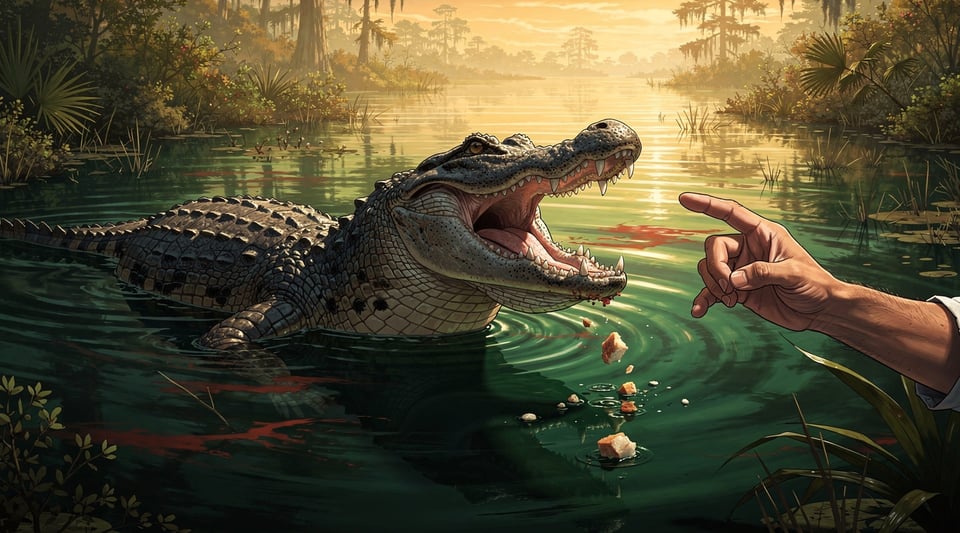
When humans feed alligators, the animals lose their instinctive fear of people and begin to associate humans with food. This shift increases the risk of aggressive encounters — not just with the person doing the feeding, but with any human the alligator encounters afterward. Many nuisance alligator complaints filed with the FWC trace back to prior feeding by residents or tourists. Once an alligator is deemed a nuisance threat, it is typically removed and euthanized.
Enforcement, Scope, and Legal Alternatives
The Florida Fish and Wildlife Conservation Commission (FWC) actively enforces this law and operates a dedicated Statewide Nuisance Alligator Program (SNAP) and a 24/7 hotline (866-FWC-GATOR) for reports of threatening alligators. The law also covers American crocodiles, a rarer and more endangered species also found in southern Florida. Licensed wildlife parks and zoos with FWC permits are the only legal venues where members of the public can interact with or feed captive crocodilians.
Where the story gets it wrong
Many assume this law only applies to large, obviously dangerous gators in swamps, but it applies to any wild alligator anywhere in Florida — including those in residential ponds, golf course lakes, and canals.
Some tourists believe tossing food scraps to alligators is harmless or even helpful. In reality, it can directly lead to the animal being classified as a nuisance and euthanized.
The law also extends to American crocodiles, not just alligators. Feeding in licensed, FWC-permitted facilities such as gator parks and zoos remains legal — the prohibition applies only to wild, free-roaming animals.
No person shall intentionally feed, or entice with feed, any wild American alligator (Alligator mississippiensis) or American crocodile (Crocodylus acutus). Exceptions apply to persons feeding alligators maintained in permitted captivity for educational, scientific, commercial, or recreational purposes, and to Florida Fish and Wildlife Conservation Commission personnel or authorized agents when relocating alligators using bait. Any violation is a misdemeanor of the second degree, punishable under Florida Statutes §775.082 or §775.083.
- Current status
- Actively Enforced
- Enacted
- January 1, 1978
- Penalty
- Second-degree misdemeanor: up to 60 days in jail, up to 6 months probation, and up to $500 fineFine: up to USD500Imprisonment: 60 days
- Jurisdiction
- Applies statewide throughout Florida. Enforced by the Florida Fish and Wildlife Conservation Commission (FWC).