“Flag Burning IS Illegal in the U.S. — Except the Supreme Court Says It Isn't”
A federal law (18 U.S.C. § 700) makes it illegal to burn, mutilate, or desecrate the American flag — but two landmark Supreme Court rulings have rendered it nearly unenforceable as political protest, finding that such acts are protected symbolic speech under the First Amendment.
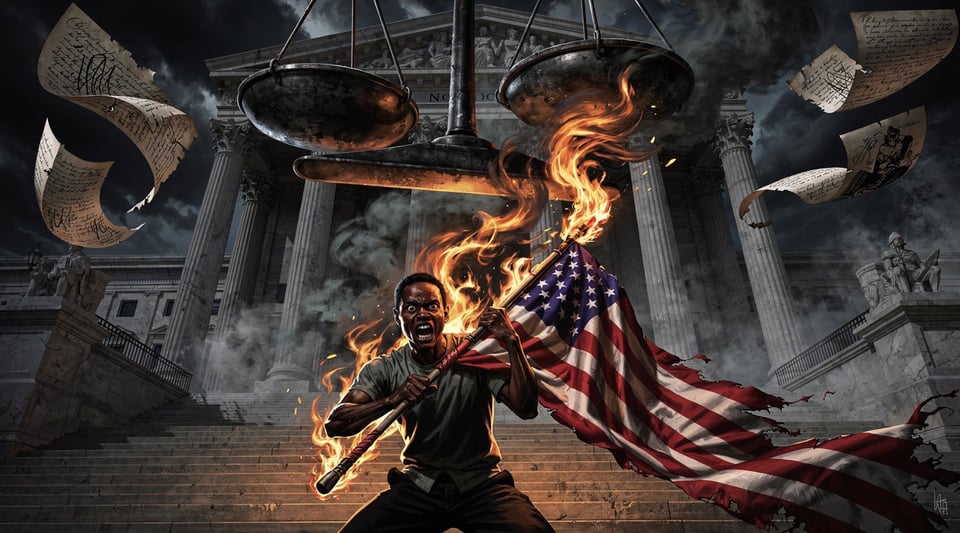
Early Flag Protection Laws
The United States has a long and turbulent legal history with flag desecration. The first federal flag protection law passed in 1968 — the Flag Protection Act — was a direct response to Vietnam War-era protests. At the time, 47 states also had their own flag desecration statutes on the books.
The Texas v. Johnson Case
The story's pivotal chapter came in 1984, when Gregory Lee Johnson burned an American flag outside the Republican National Convention in Dallas to protest Reagan administration policies. He was convicted under Texas law, fined, and sentenced to a year in prison. His case climbed all the way to the Supreme Court. In the landmark 1989 case Texas v. Johnson (491 U.S. 397), a closely divided 5–4 Court held that flag burning constituted protected symbolic speech under the First Amendment. The majority included both liberal and conservative justices — Brennan, Marshall, Blackmun, Kennedy, and Scalia.
Congress Fights Back Again
Congress immediately fought back, passing the Flag Protection Act of 1989, which tried to craft a 'content neutral' version of the ban. Within months, in United States v. Eichman (1990), the Supreme Court struck that law down too, again 5–4. Despite these rulings, 18 U.S.C. § 700 was never formally repealed and remains in the U.S. Code to this day. Legal experts describe it as largely unenforceable against political protesters, though prosecutors may still pursue flag-related charges when the conduct independently violates other laws (arson, destruction of property, disturbing the peace).
2025 Executive Order Reignites Debate
The debate reignited dramatically in August 2025, when President Trump signed Executive Order 14341, directing the DOJ to aggressively prosecute flag desecration cases to the maximum extent the Constitution allows — including using fighting words doctrine, incitement exceptions, and immigration enforcement against foreign nationals. Legal analysts noted the order carefully hedged within First Amendment limits.
Where the story gets it wrong
Many assume flag burning is either completely legal or straightforwardly illegal nationwide. In truth, 18 U.S.C. § 700 remains on the books, but Supreme Court rulings render it unenforceable against political expression. It may still apply to non-expressive desecration, destruction of government property, or acts constituting 'fighting words' or incitement to imminent lawless action.
18 U.S.C. § 700(a)(1) states: 'Whoever knowingly mutilates, defaces, physically defiles, burns, maintains on the floor or ground, or tramples upon any flag of the United States shall be fined under this title or imprisoned for not more than one year, or both.' Subsection (a)(2) exempts conduct related to the disposal of a worn or soiled flag. The law defines a U.S. flag as any flag made of any substance, of any size, in a form that is commonly displayed.
- Current status
- Rarely Enforced
- Enacted
- July 5, 1968
- Penalty
- Up to 1 year imprisonment and/or a fine (up to $100,000 under general federal fining statutes, 18 U.S.C. § 3571). However, enforcement against political protesters has been blocked by Supreme Court precedent since 1989–1990.Fine: up to USD100,000Imprisonment: 1 year
- Jurisdiction
- 18 U.S.C. § 700 is a federal statute applying nationwide. Individual states previously had their own flag desecration laws, most of which were also rendered unenforceable by Texas v. Johnson (1989). Executive Order 14341 (2025) directs federal agencies to also refer cases to state and local authorities where state-level laws may still apply.