“Boom Goes the Fishing Rod: Utah Bans Dynamite and Explosives for Fishing”
Utah law explicitly prohibits the use of any explosive, chemical, or other destructive method to take fish or crayfish from state waters. The restriction is codified in the Utah Administrative Code and actively enforced by the Division of Wildlife Resources.
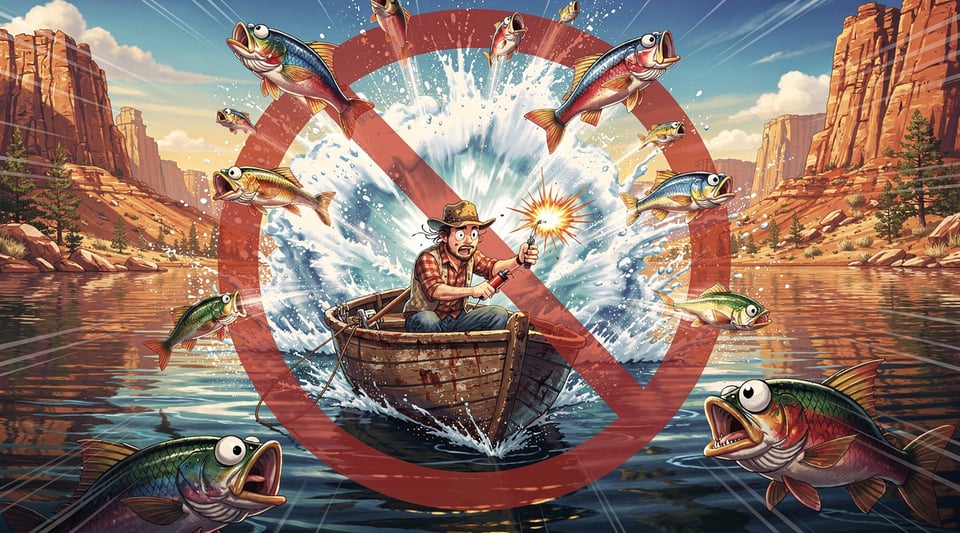
Utah's Real Ban On Dynamite Fishing
It might sound like a joke from an action movie, but Utah actually had to write a law banning people from fishing with dynamite — and it's still on the books. The prohibition is part of Utah Admin. Code R657-13-11, the state's comprehensive rule on taking fish and crayfish, established under the authority of the Utah Wildlife Board.
Dynamite Fishing's History In The American West
Blast fishing — also known as dynamite fishing or bomb fishing — is a globally recognized destructive practice where explosives are detonated in water to stun or kill fish, which then float to the surface for easy collection. While the practice is more commonly associated with subsistence fishing in Southeast Asia and parts of Africa, the historical use of explosives, chemicals, and poisons to take fish was widespread in the American West during the late 19th and early 20th centuries, often in conjunction with mining and logging operations that left plenty of dynamite around.
Why The Ban Protects Aquatic Ecosystems
The rationale for the ban goes beyond mere fairness. Explosives kill indiscriminately — not just the target fish, but eggs, juveniles, invertebrates, and any other aquatic life within the blast radius. They also destroy habitat structure in rivers, lakes, and streambeds. Utah's cold-water fisheries, including populations of native cutthroat trout and other protected species, are particularly sensitive to such disruption.
Scope Of The Rule And Its Penalties
The regulation bans not just explosives but also poisons, electricity (i.e., unauthorized electrofishing), firearms, and even pellet guns for taking fish — painting a picture of creative historical workarounds that regulators had to specifically address. Limited exemptions do exist: the Division of Wildlife Resources may authorize chemicals or electricity for official surveys, and certain archery equipment is permitted for specific invasive species like carp. Violations of Utah's wildlife taking rules are generally treated as Class B misdemeanors and can result in fines, jail time, and revocation of fishing licenses.
Where the story gets it wrong
Many treat this as a quirky, likely obscure or unenforced 'weird law.' In reality, it is an active, substantive wildlife regulation with a clear conservation rationale, codified in the Utah Administrative Code and enforced by the Division of Wildlife Resources.
The rule is sometimes assumed to ban only dynamite. It actually prohibits all chemicals, poisons, electricity, and several types of weapons used to take fish, with a narrow exception for authorized wildlife management activities such as fish surveys.
Under Utah Admin. Code R657-13-11(2): 'A person may not obstruct a waterway, use a chemical, explosive, electricity, poison, crossbow, firearm, pellet gun, or archery equipment to take fish or crayfish,' except as specifically provided in limited circumstances authorized by the Wildlife Board (e.g., invasive species control or authorized fishery surveys). The rule applies statewide to all public waters.
- Current status
- Actively Enforced
- Penalty
- Class B misdemeanor under Utah wildlife law; up to 180 days in jail and/or fines. Additional consequences may include revocation or suspension of fishing and hunting licenses by the Division of Wildlife Resources.Imprisonment: 180 days
- Jurisdiction
- Applies statewide across all public waters of Utah. Administered by the Utah Division of Wildlife Resources under the Utah Wildlife Board.