“Utah Once Banned Public Swearing — Then Courts Said 'Hell No'”
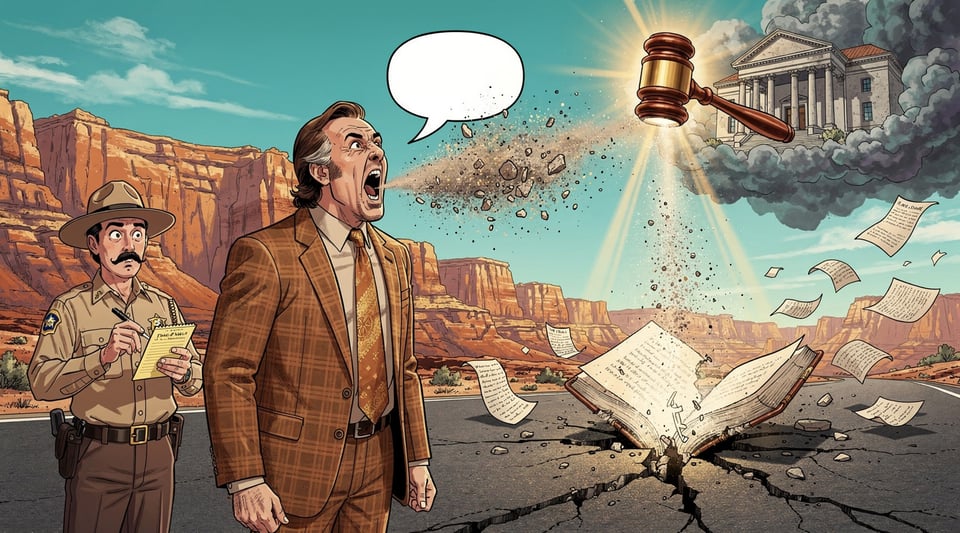
Utah's disorderly conduct law once included 'abusive or obscene language' as a punishable offense, but that provision was struck down by courts and removed from state law in 1999. Today, casual public swearing is not a crime under Utah state law, though some municipal ordinances can restrict profanity when it rises to the level of a breach of the peace.
Origins of the disorderly conduct law
The story of Utah's public swearing law is really the story of how the First Amendment gradually chipped away at morality-based speech restrictions across America. Utah's original 1973 disorderly conduct statute, § 76-9-102, did include 'abusive or obscene language' in a public place as a criminal offense — reflecting the conservative cultural norms of the era, particularly in a state shaped by the Church of Jesus Christ of Latter-day Saints.
The Huber case and court reversal
The provision had real bite: in 1988, a Logan City man named Ralph Lowell Huber was convicted under a parallel city ordinance after cursing at police officers who pulled him over. Utah's Court of Appeals unanimously reversed the conviction, ruling the ordinance unconstitutionally overbroad under both the U.S. and Utah constitutions. The court held that the First Amendment does not permit punishing mere offensive language unless it constitutes 'fighting words' — a narrow category of face-to-face insults likely to provoke an immediate violent reaction.
Legislative repeal and lingering claims
Following that ruling and related Utah Supreme Court guidance, the state legislature in 1999 passed H.B. 217, formally deleting the 'abusive or obscene language' clause from § 76-9-102. The provision has a real historical basis, and some municipal-level restrictions on profanity that causes a breach of the peace remain on the books. The claim circulates widely on 'weird laws' listicle sites, which typically fail to note that the provision was repealed over 25 years ago.
Where the story gets it wrong
Some sources present this as current Utah law, referencing the pre-1999 version of § 76-9-102, which was amended to remove the profanity clause after courts ruled it unconstitutional. The law as commonly described — a blanket statewide ban on public swearing — has not existed for over 25 years.
Additional confusion arises from Utah Code § 10-8-50, which allows cities to pass ordinances restricting profanity when it could cause a breach of the peace. This is not a statewide prohibition and requires conduct beyond mere casual swearing.
Current Utah Code § 76-9-102 defines disorderly conduct as: refusing to comply with a lawful police order, engaging in fighting or violent/threatening behavior, making unreasonable noises in a public place, or obstructing traffic. The original version (in force from 1973 until 1999) also included subsection (iv): 'engaging in abusive or obscene language or making obscene gestures in a public place.' That subsection was explicitly deleted by H.B. 217 in 1999. Separately, Utah Code § 10-8-50 enables city councils to punish 'using obscene or profane language in a place or under circumstances which could cause a breach of the peace' — but this is a municipal enabling provision, not a statewide ban, and it requires a nexus to a breach of the peace.
- Current status
- Repealed
- Enacted
- January 1, 1973
- Repealed
- January 1, 1999
- Penalty
- Historical penalty (pre-1999): Class C misdemeanor if offense continued after being asked to stop; otherwise an infraction. After 1999 amendment, swearing alone is no longer a punishable offense under state law.Fine: up to USD750Imprisonment: 90 days
- Jurisdiction
- Utah, USA. The historical statewide provision (§ 76-9-102) was repealed in 1999. A municipal enabling statute (§ 10-8-50) allows city-level ordinances linking profanity to breach of the peace.